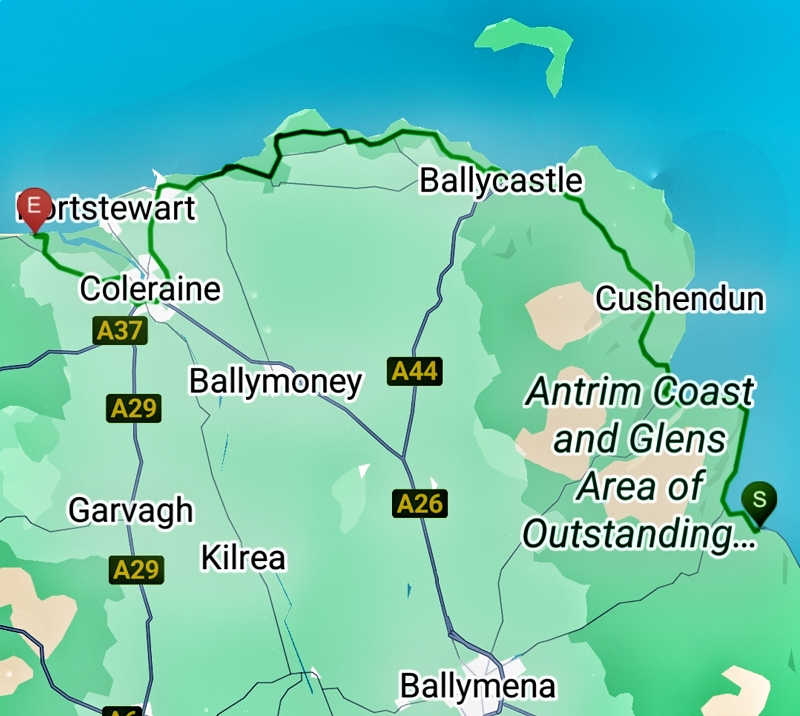
A fine morning greeted us at Glenarm, but we were ready to trek northwest towards the Causeway. What a beautiful road the Causeway Coast Road is too. Sweeping panoramas across the sea as far as Scotland again. Twists and turns. Cliffs and glens. It has it all.
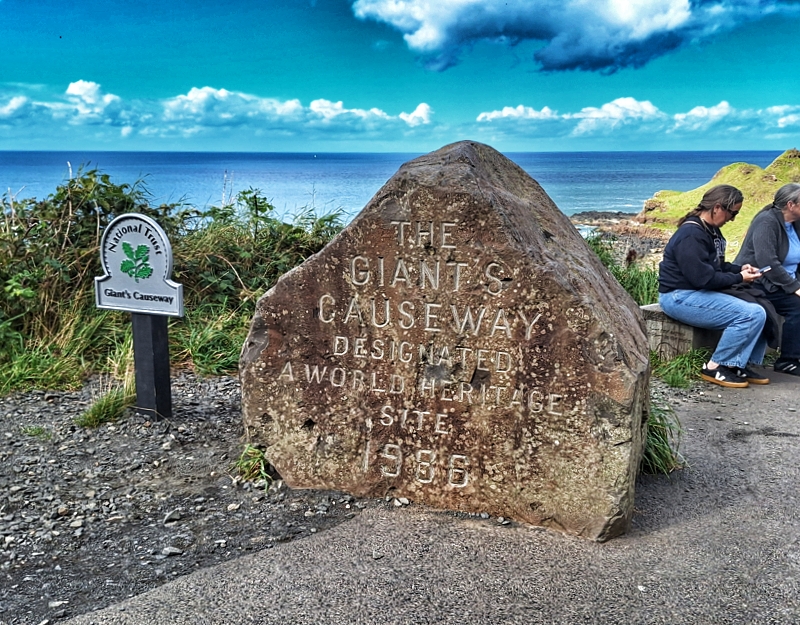
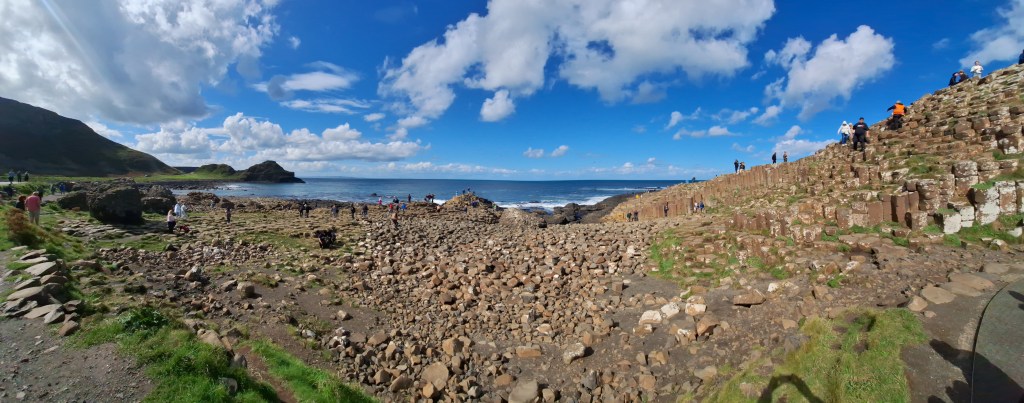
Reaching The Giant’s Causeway itself, you’re faced with a choice of a long walk to the area (possibly from Bushmills) or a rather hefty charge for the NT visitor centre – or a slightly lesser one from a nearby car park. We chose the latter.
It’s still a fair walk from there, but very doable.
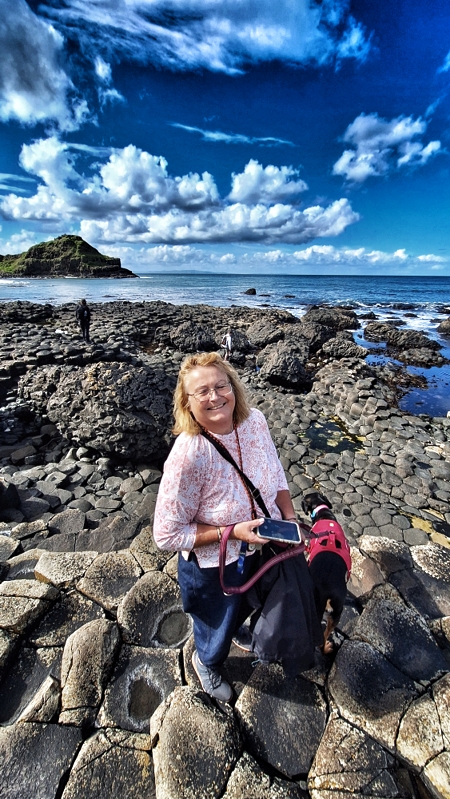
Look how happy she is to see her pile of rocks at last
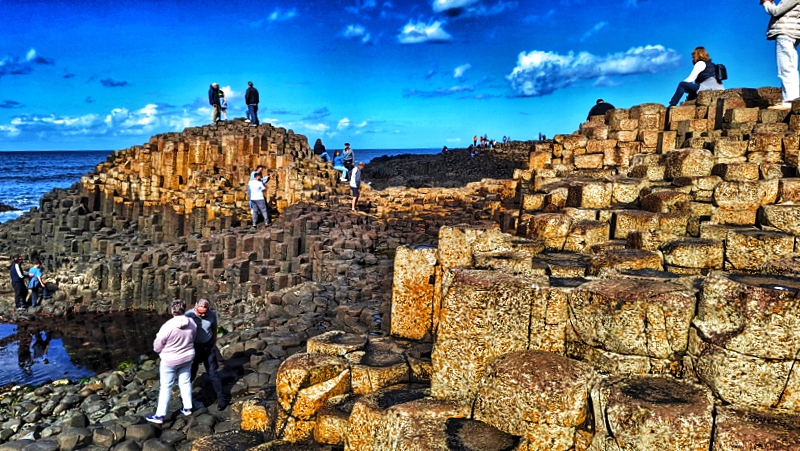
I don’t know how long it took to lay all those blocks, but whoever did it deserved their bonuses. I can’t believe Finn/Fionn did it all on his lonesome, even if he was very big-boned.
There’s a lot of it too…
We finished with a well deserved coffee at the Causeway Hotel after the mostly uphill tab back out.
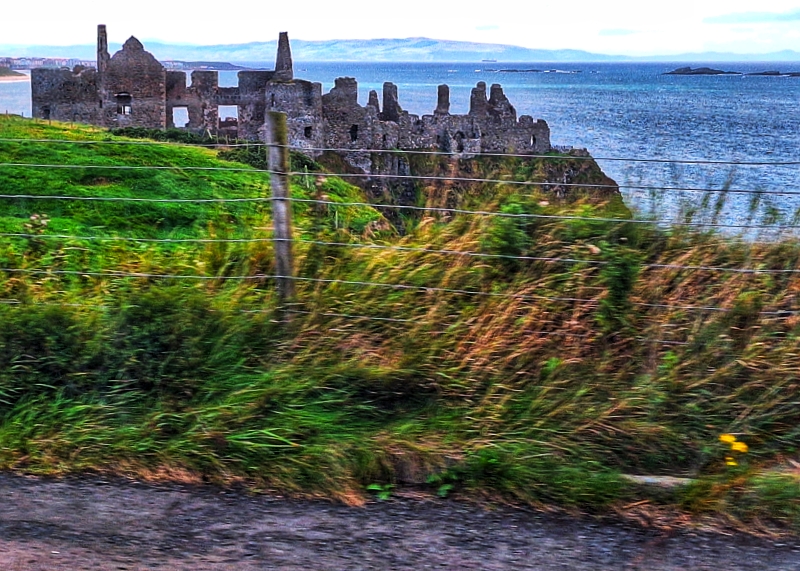
M’s next agenda item was to visit her ancestral home, not far away – Dunluce Castle. I think she had plans to move in, but changed her mind when she saw the state the last residents had left it in. Tch.
A few tiles short of a roof.
From there, we kept the coast to our right as far as possible passing through Portrush and Portstewart but were forced to turn inland for several miles to skirt Coleraine and cross the River Bann there before heading north again towards tonight’s park-up at Castlerock.
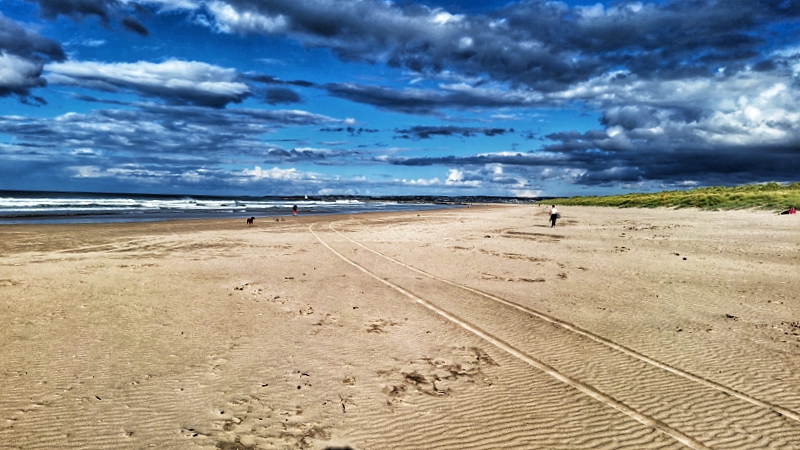
Once again, it’s not exactly Blackpool (thank the Lord) but it’s pleasant enough, and has an absolutely beautiful soft-sandy beach that goes on and on. Lacy had a ball.
The park-up is not the prettiest as it’s just a small car park at the entrance to the Black Glen. It overlooks a caravan park, sadly, but at least there’s a sea view over the top of the sea of aluminium.
It’ll do for the night, however, and certainly seems quiet enough.
It’s pretty chilly though, under the clear sky. Autumn’s just around the headland (so’s Eire!) so it’s heating switched-on and shut-up-shop time.
Tuesday 9th September 2025
Cool and dull, with a few spots of H2O. Nothing like enough to dampen the follicles though.
It was a very quiet night again. I’m beginning to wonder where the youth of Ireland do their doughnuts and boom-boom music – but complain I not.
We set off at around 11, heading for Derry’s bypass road that cuts across the mighty Foyle River (and it really is wide just there) at the foot end of what I take to be the second largest lough. First stop; Muff, right on the border just north of Derry, for fuel and coffee at the very well appointed Spar. Perhaps we should’ve filled the tank in NI, as I think it’s cheaper there, but I haven’t worked the conversion. I probably won’t either, as it’s done now.
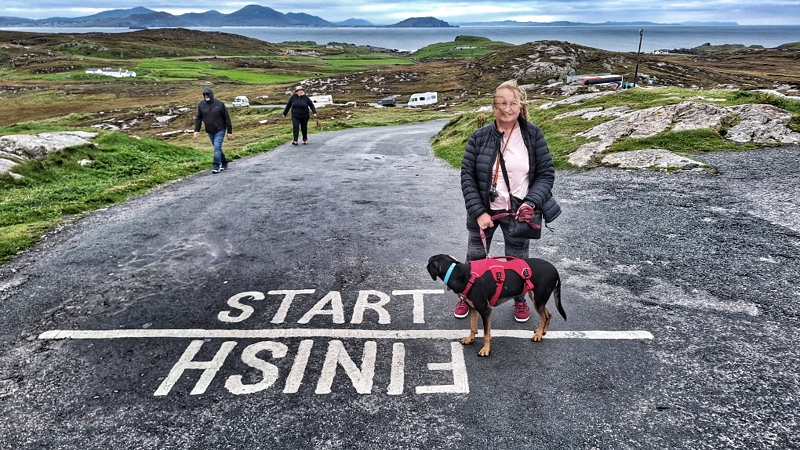
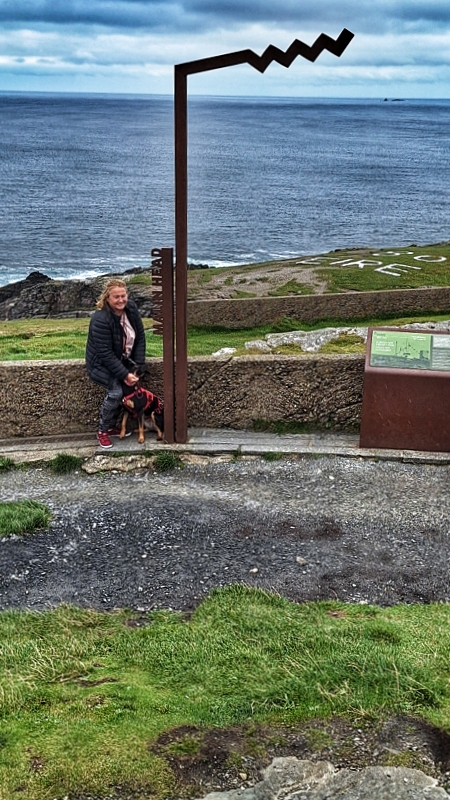
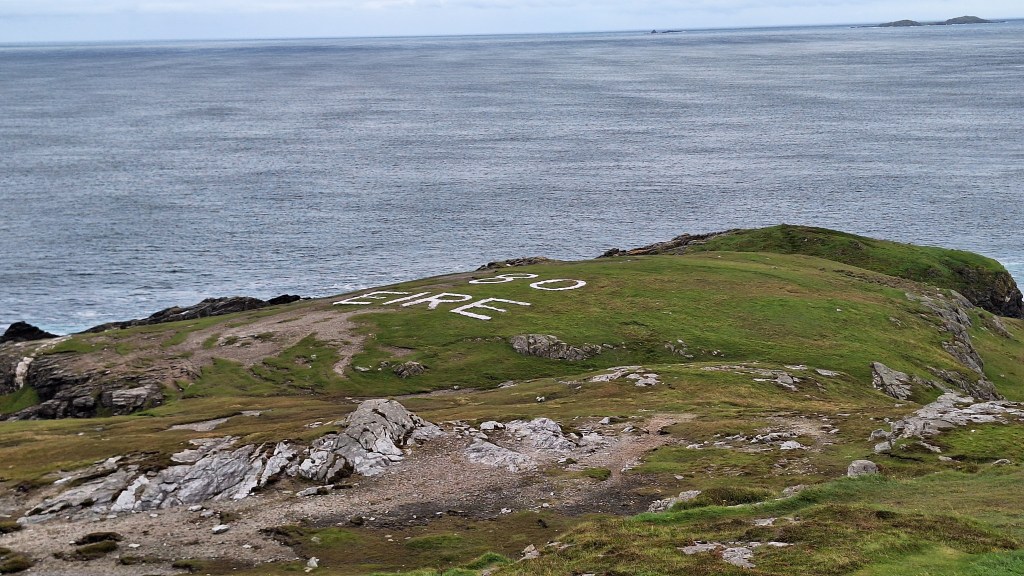
Next stop – at the other end of the Inishowen peninsula – Malin Head. Northernmost point of Ireland, and the beginning (or indeed end) of the Wild Atlantic Way.
That’s what it says(you can just pick out the van in the background).
We’d originally intended to pick up the WAW a bit further down, but we kinda accidentally ended up here, so it’s nice to be able to do the whole thing, from here to Cork-way.
We’ll also take in Mizen Head (brings back great memories of a wonderful holiday around those parts when the girls were young) thus completing the North-South traverse of the island.
View from the Head
A quick sandwich lunch in the van later, and we were off back the way we came, right-turning just south of Malin village, en-route to Tullagh Bay beach for another very wild park-up overlooking the whole length of this beautiful strand. Surrounded by mountains and crashing waves just feet away, it’s pretty perfect here..
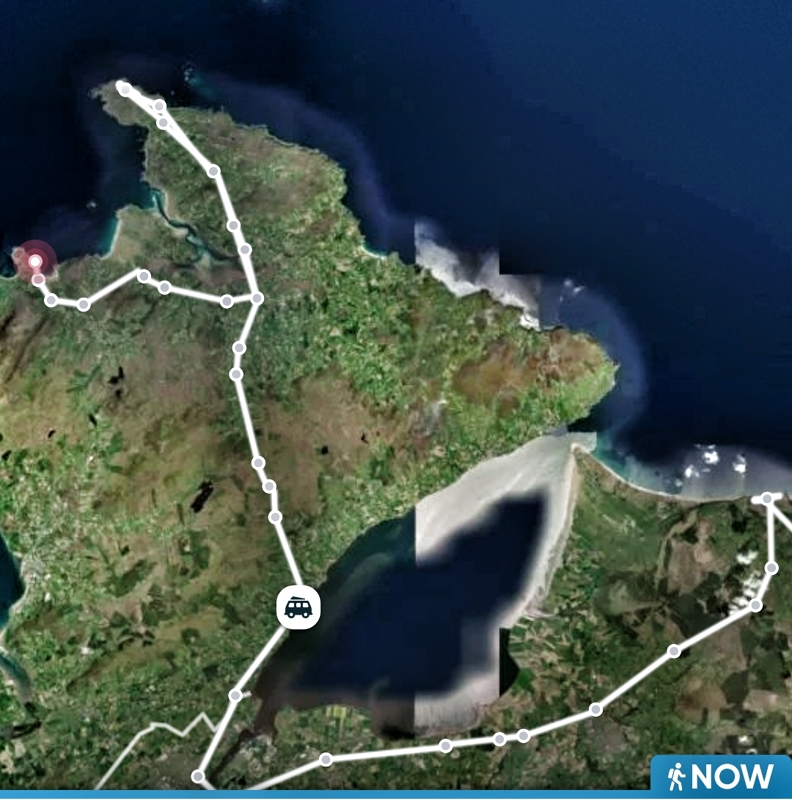
One thing. Having returned to the Republic, we’ve once again lost the use of our cheapo tracker, which relies on a 2g signal. Guess what? EE have already shut down their 2g service here, so that’s done for that.
Oh well; just Polar Steps routes from now on then… Poor show. Sorry!
Even though last night’s park-up was near-perfect; scenic and peaceful, we thought this morning was time to move on and recover a little of our disrupted schedule, such as it is.
Erne to Glenarm (and Mull of Kintyre, SW Scotland, in the top RH corner…)
Enniskillen to Glenarm is a fair schlep from (near) the west coast to County Antrim’s east coast. The roads are decent enough, though (except when that bleddy Google Maps doesn’t know what it’s doing. Nothing unusual there) and with a late start and a stop in Omagh’s Lidl for provisions, we saw the sea around mid-afternoon.
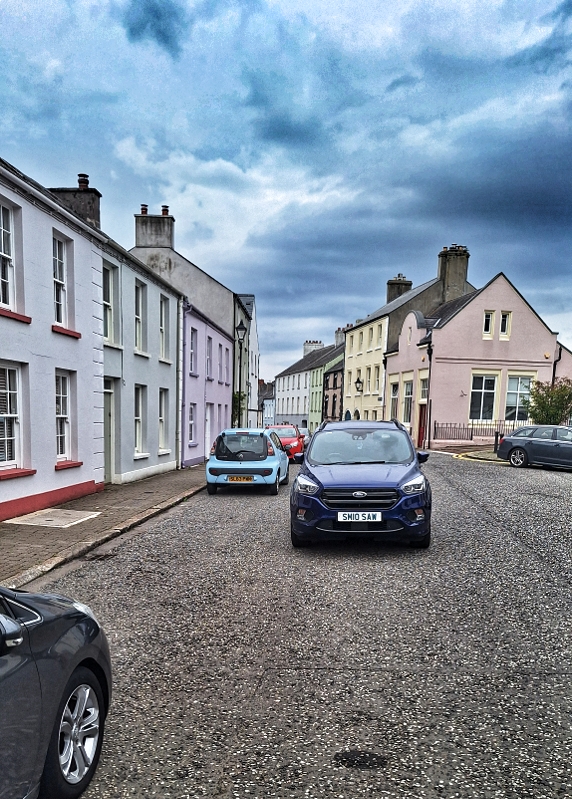
Sure and you know you’re in Ireland when there are cars randomly parked in the middle of the road
Glenarm is pretty enough, although there’s little here. What it does have, though, is otters browsing for their supper in the harbour water below (not a good photo opportunity, sadly, as it’s just too dark) as we eat our own pasta supper. It also has a view of the the Mull of Kintyre.
Mull of Kintyre from the harbour wall
Surprisingly close it is too, and clearly visible now the mistiness of earlier has cleared.
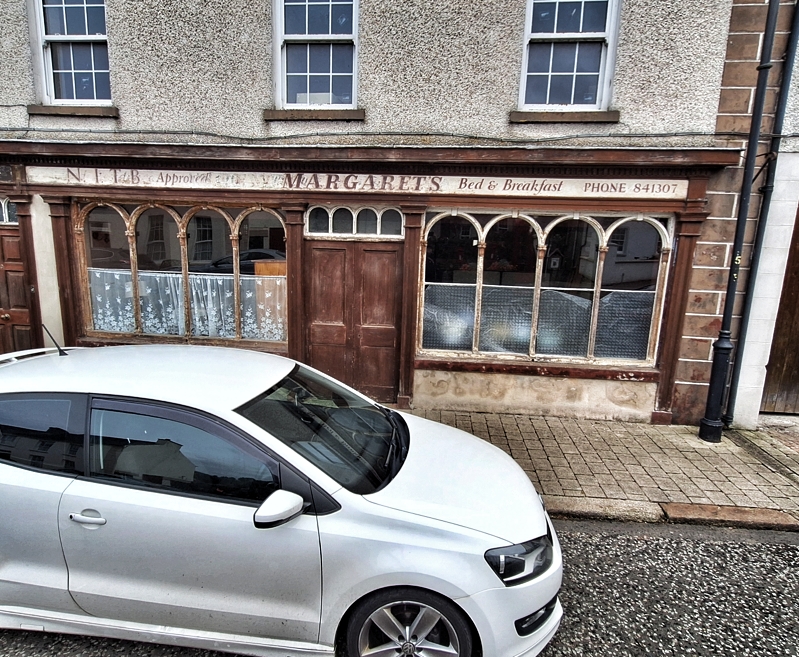
Northern Ireland Tourist Board approved, I’ll have you know! (Maybe thirty years ago…)
There’s also a burger van, which smells good, if that’s your thing (and the coffee was pretty decent and very cheap). And apparently you can order takeaways for delivery in the pubs, which are very happy for you to consume them there (Chinese food is no doubt good for the beer trade!).
We’ve settled for the night at the Glenarm Marina, which welcomes motorhomes and campervans, with pretty decent facilities, and is totally free. Take note England, as I may well have said before…
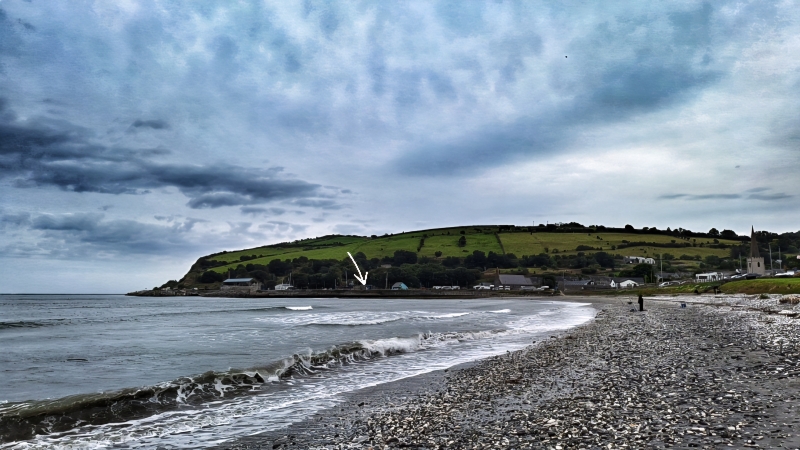
Nice, long, beach. We’re at the far end – arrowed. Beach is much sandier at that end
All being well, we’ll stay here tomorrow night too before making our way along the Causeway road on Monday.
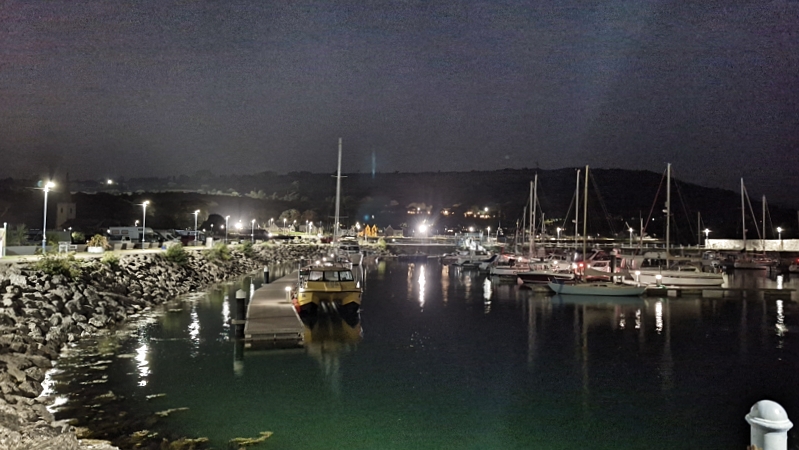
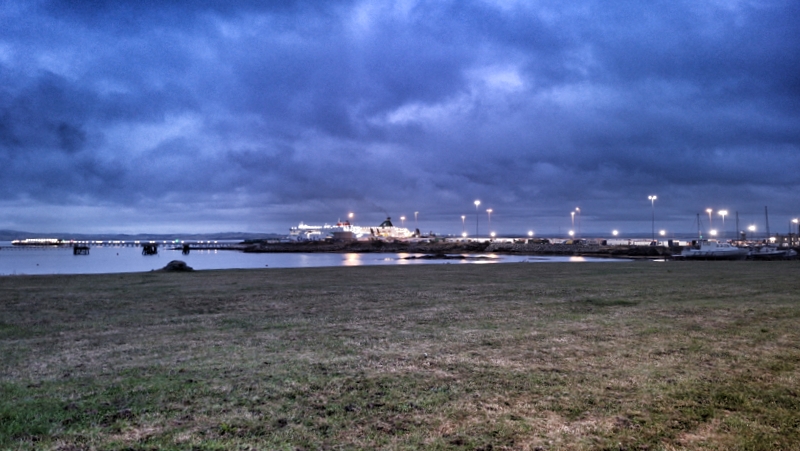
Glenarm Marina by night.
Sunday 7th September 2025
What a miserable day, weather-wise. Heavy rain or drizzle most of the time, with short spells of slight brighness (and that’s being kind to it).
We walked up to the tea rooms in the castle grounds, but… no dags!
So we walked back into the village and spent our money in the Cove Café instead. What a difference. A warm welcome, plenty of tables, good coffee, and great cakes. And they were obviously dog lovers. Highly recommended.
The rest of the afternoon was just spent hunkered down in the van, reading, drinking tea and coffee, and generally avoiding the weather. Her Lacyship looked fit to burst though. Poor thing just wants to run on the beach. Too wet, too windy, and too tide-in though.
And that was pretty much Sunday. Tomorrow, we roll north and west along the lovely Antrim coast, hopefully in slightly better weather.
We left the marina just after 10am, northbound for the Giants Causeway, filled the fuel tank near the border, and headed for Enniskillen.
And Enniskillen is where it all went wrong.
We’d just passed the city centre when M noticed the red battery warning lamp was on. Bugger. Fortunately there was a EuroSpar just ahead, so we pulled in, popped the bonnet, expecting to find the belt gone – but no.
It’s the alternator as far as we can tell.
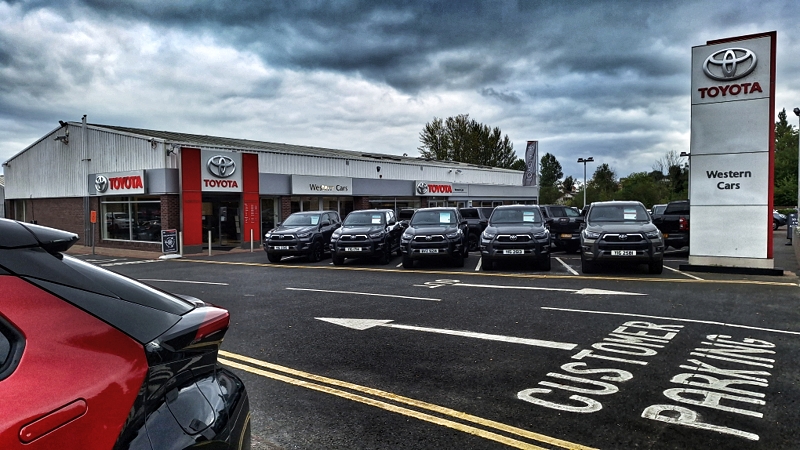
Luckily, there is Western Cars Toyota nearby in Enniskillen, so I gave them a call to see if there was any hope of a fix, and, boy, did they come through.
Fortunately, although the battery had run flat by the time we’d stopped, the solar panel put enough back in to enable a start fairly quickly (I have a jump pack failing that), so we were able to follow the car they’d sent out to us the fairly short distance, but through sticky traffic, to the dealer’s premises.
We’re not out of the woods yet though, as we are currently sitting in the Service Reception (with tea!), awaiting news of the fix prognosis.
What they have said, though, is that they will attempt to get the alternator overhauled at a place a few miles away, otherwise it would likely be well into next week before a new one could be delivered.
So, it’s all fingers crossed, although I’m fully expecting we’re going to be camping in the customer parking area until Monday at least. Deep joy.
Home for the night – or more?
It could be worse though. We could have had to shell out for a very expensive local B&B for a few days, on top of a new alternator. At least with the folks here doing all they possibly can to help us out of a bad situation at as low cost as possible, much of the initial stress has now dissipated.
Thankful for small (all) mercies, and all that!
At least we’re a reasonable walking distance from the centre of Enniskillen, and it seems a nice place with plenty to offer. Here’s hoping the weather isn’t too unkind during our mooching and browsing – and it hasn’t been so far today.
Update at 3.50pm
We’ve just been given the incredibly welcome news that the altermator has been fixed (I’m assuming diodes, but no real idea as yet) and we should be on our way by 5pm! That’s absolutely amazing, and testament once again to Toyota and their dealerships’ commitment.
Obviously our original intended destination is now off the cards, but who cares? We have five weeks!
All we have to do now is pay(!) and then find somewhere not too far away to spend the night…
Update at 6.45pm
We paid (ouch). It turned out that the starter battery had some duff cells too (clearly evidenced, even though I didn’t ask to see it tested) so a new one added to the overall cost. To be honest, I sort of knew it was on its way out, as it had failed us last winter, and it seems it was only limping on due to the solar input covering up the inevitable (and that would probably not been enough in the dull cold of the oncoming winter).
So there we have it: A rebuilt generator and a new battery for it to play with. And I really can’t overstate how fantastic everyone at Western were/are, bending over backwards to get a good resolution for us. Very highly recommended!
Hopefully that’s an end to the bad luck. (Don’t say that you bleddy fool!).
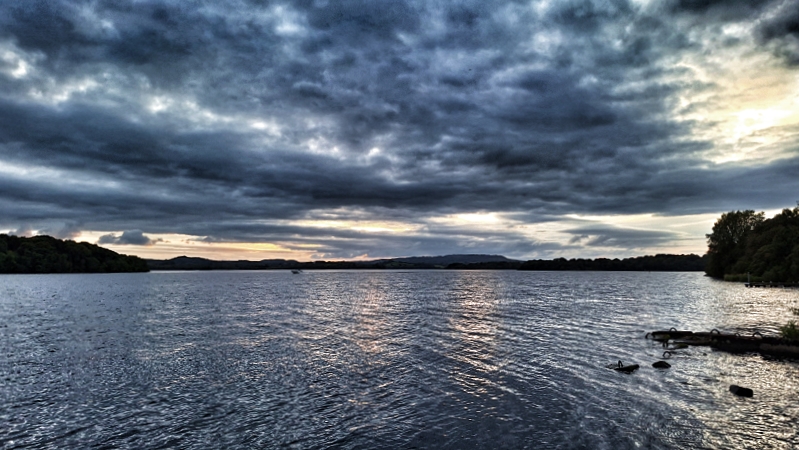
Good luck, now, though – we’ve driven around ten miles north along the eastern shore of the Lower Lough Erne and found what appears, on the face of it, to be a perfect park-up. Peaceful (so far) and with a picnic bench adjacent, and lovely views across the Lough.
Even the weather is holding on. .
Plans change, and with all that’s happened we’ve decided to put the Giant’s Causeway back until Monday and see a little more of the northern and north-eastern coast of Ulster over the next couple of days.
It was a foul start to the morning, and an early one, as we had to be in place in the ferry queue before 7.15am. We’d almost forgotten what proper rain was, but we soon had our memories refreshed. It was throwing it down.
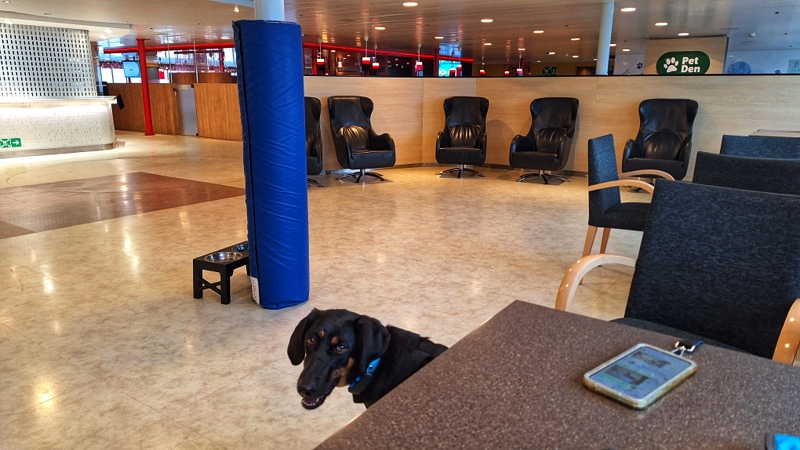
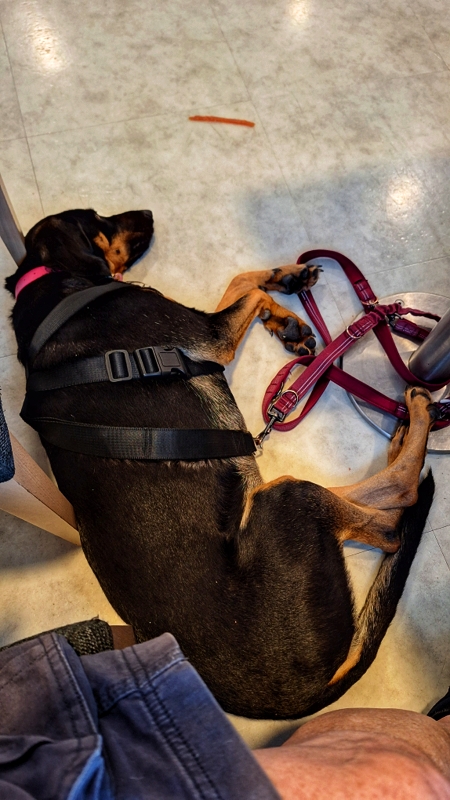
Number of passengers in the ‘Pet Den’: Three (M, mesen, and her Lacyship)!
Seems chilled enough
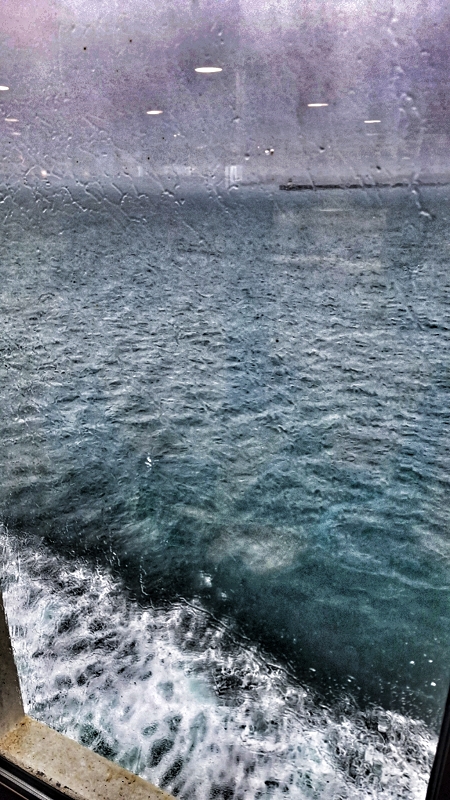
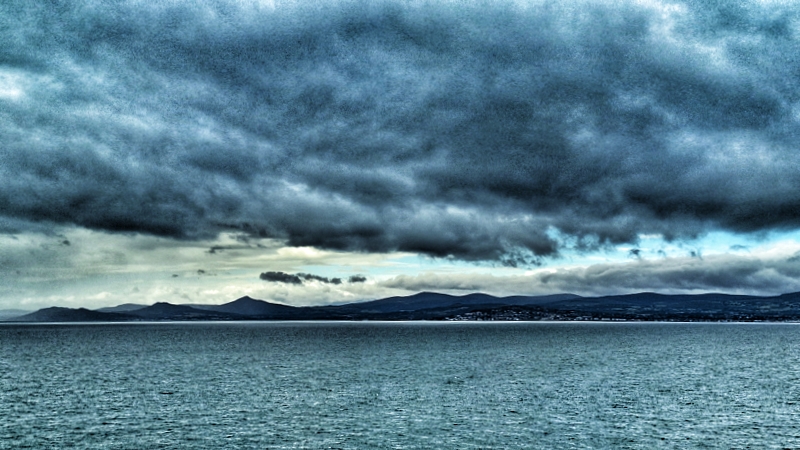
Mind you, within half an hour of departure, the outlook had vastly improved to the point we could actually see what looked very much like the normal horizon. Perhaps things were looking up?
The Wicklow Mountains and Dublin (just about)
Dublin seemed to hove into view almost too quickly, and the EE ‘welcome to Eire’ message popped up little more than an hour after leaving Wales, enabling me to quickly (re)publish yesterday’s blog before we descended into the Cyprus-registered ship’s diesel-stinky bowels once more (via a lift as Lacy is decidely anti steel-open-tread stairs).
As usual with us, there was an issue with getting off the ferry due to lorry trailers blocking a couple of rows (including ours) in, meaning it took far longer to move than it should’ve. However, once outside, it all went smoothly and quickly enough, including the pet control checkpoint, run by a lovely lady who gave us the almost-obligatory ‘welcome home’ greeting!
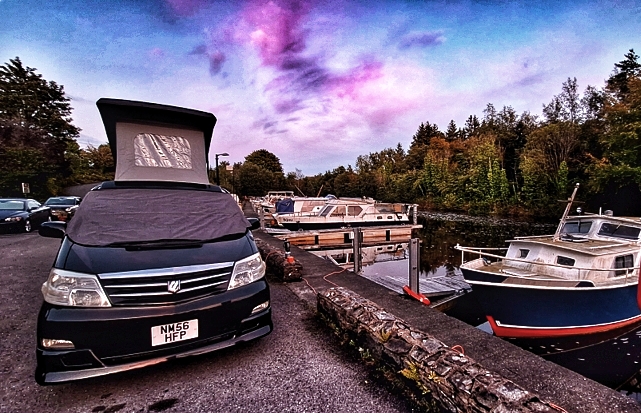
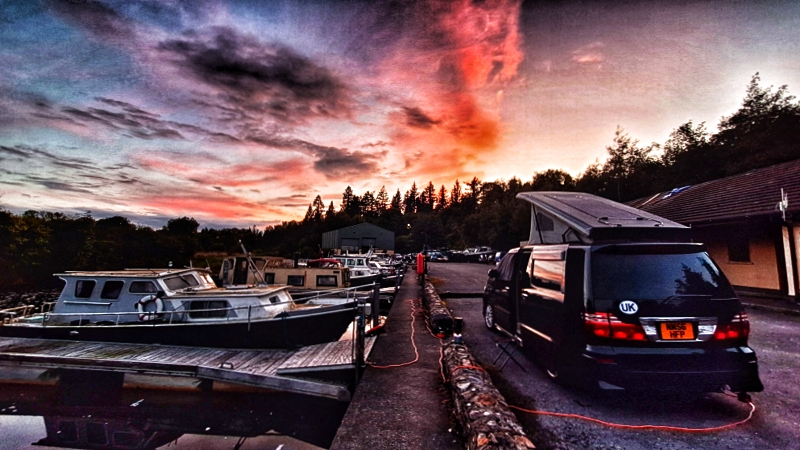
After fighting the Dublin traffic (fairly grim), we emerged onto the N3 heading northwest through the on-off rain showers (mostly ‘off’ fortunately) and Navan and Cavan, and thence to Killykeen forest park for a couple of hours and a sandwich and coffee. We’d thought about staying the night; it’s a lovely and peaceful spot, but there’s some doubt whether overnight parking is allowed (reviews vary on this point on Search for Sites) so we moved on, fortified, to the private marina at Ballinamore. This charges 15€ per night, but has full facilities, is obviously right by the water, and is nice and secure, so no complaints here. Try and get that kind of price for a night on a campsite with EHU, water, dumping, toilets, and showers.
There was one minor problem on setting up, though. Hooking up to the power post resulted in nada electric, and had the marina’s owner fetching us a known good cable, to no avail. It turned out to be the van’s ‘fusebox’ which had either tripped, or more likely, been accidentally switched off while we were packing. It was sorted quite quickly
Looking East…
…and west.
It’s pleasant enough too, and just a short amble to the town centre – so we may well stay for a couple of nights.
4th September 2025
Well, that was a really peaceful night
We both (all) slept pretty well, which is not surprising given that we didn’t sleep too well the night before, and it was a long travel day.
We awoke to sun and showers – some really bright ,warm sun, and some quite heavy showers. But it’s warm enough, and it dried up by 2pm, so no worries (apart from Lacy’s POV as she just loves lying outside, but no way do we need a wet dog in the van!).
A sturdy brunch with copious amounts of tea and coffee set us up nicely for a wander up into Ballinamore.
It’s a funny little town, but very friendly, if you can go by the greetings in the street, the compliments re. Lacy, and the service in the cafe where we topped up our caffeine levels.
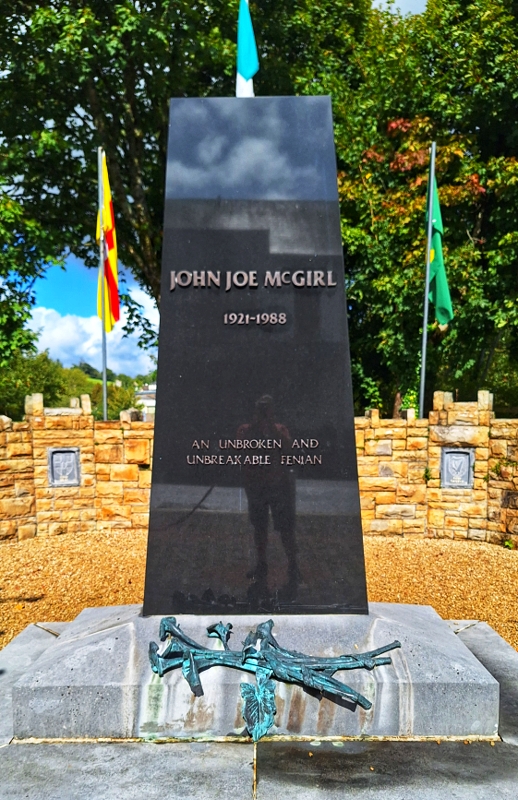
It’s also very much a republican town, celebrating councillor and Sinn Féin man John Joe McGirl – an ‘unbroken and unbreakable Fenian’ with a large polished and well cared-for memorial. His is an eye-opening story that bears looking up.
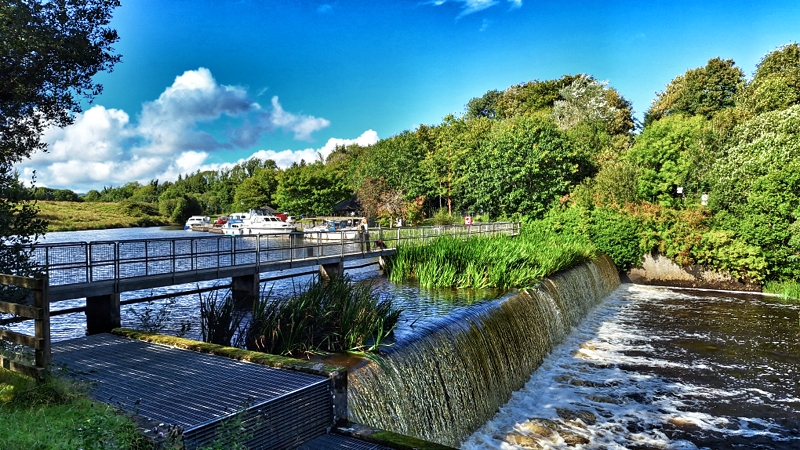
Just along from there, by the the walkway between the bifurcated channels of the canal navigation, is a weir dropping the one course level noisily some six or eight feet, with an adjacent corresponding lock on the parallel navigation.
The weir and the public marina beyond
It’s not a busy stretch of water here at this time of the year, but we’ve been passed by a narrowboat, a couple of large cruisers, and a few utilitarian-looking barges. Most of the vessels moored here at the private marina don’t look as though they see much service though – and a good many would benefit from a good stiff brushing down!
There were a couple of fancy looking craft at the public marina, which is run by Waterways Ireland, however. There’s free overnighting available there too, and it was on our radar for our first night(s) , but the lure of the private marina just won out as we were still finding our feet in Eire. Had we been a bit further into the trip, I reckon we’d have used it, and it really does look a pleasant spot. Waterways Ireland smart cards are also available to purchase, which give access to showers etc. at all their many marina-type facilities, and would be a worthwhile purchase if we were staying in the area longer rather than heading off towards the north coast tomorrow. Maybe if we’re passing again…
Time to settle in for the evening though, and to plan tomorrow’s route to the Giant’s Causeway (tourist trap? Maybe, maybe not, but it’s on the list!).
I published this (or so I thought) yesterday, but it appears to have floated off into the ether, so here’s a quick replacement, with my apologies. (I’m currently working on 1.4…).
Oddly enough, the post has remained in Facebook, so I’ve been able to copy it from there. Hopefully it’ll publish correctly to zigzagwanderer.co.uk this time.
2nd September 2025:
The time has finally arrived for ZZW’s first proper trip – to the Emerald Isle, north and south, Eire and Ulster – and Eire again..
We took the long (as it turned out) way to tonight’s park up in Holyhead. I well recall, many moons ago, that the A5 was the quickest/shortest/most scenic route to the north west of Wales. However, things have changed somewhat over the years, although it’s still quite ravishing when you progress past England’s sprawl into the lumpy bits, but now it’s nothing like so straightforward or direct. Google (boo) and Waze (almost as much boo) are quite insistent on making one detour via the north coast road, and I’m sure it would have been quicker, and also quite attractive, but I was having none of that, and fought both hideous apps to an ignominious defeat.
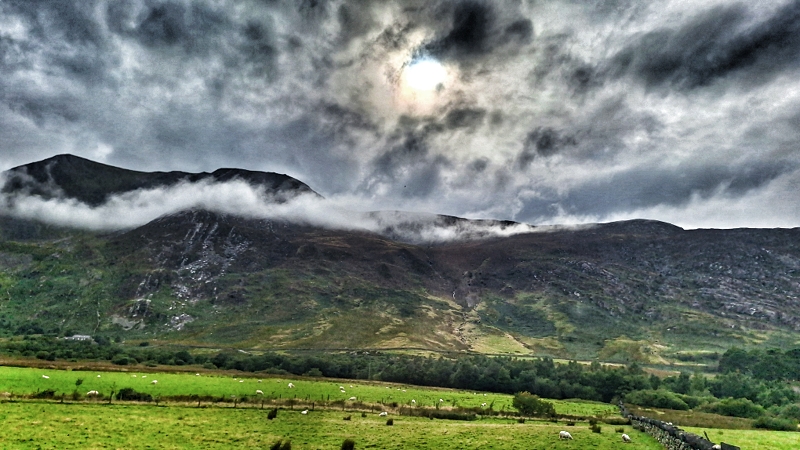
Lovely, misty Snowdonia
Anyway, we made it, and parked in our booked space between Asda and McDonalds – and quickly changed our minds as we really couldn’t see any faint possibility of any kind of peace given the constant stream of burger-monkeys.
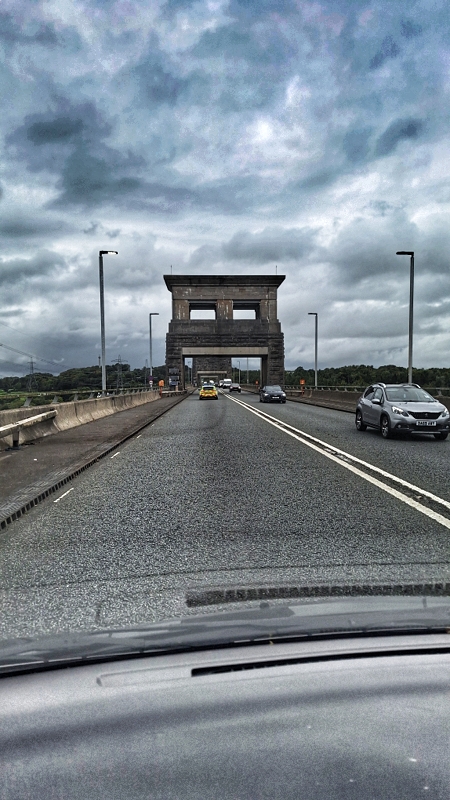
Britannia Bridge on to Anglesey…
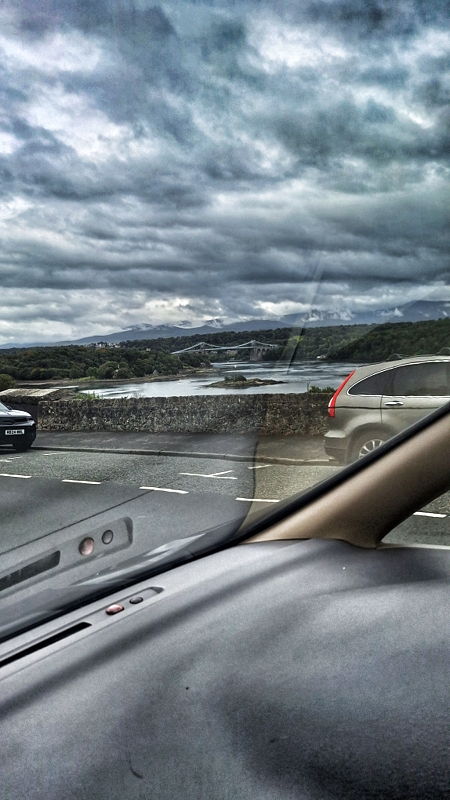
…and the Menai Bridge, for completeness
Logging onto Search for Sites quickly threw up a couple of potential improvements, though, so off we toddled to a far more promising – and free – spot, overlooking the ferry berths.
Stena and Irish Ferries readying for their night crossings (view from our park-up)
Dog emptied and bellies filled (in our case with butter chicken, rice, and papads) we started to feel the familiar pattern of settling into it. Here’s hoping!
We’ll see what the morning brings, but Aunty Beeb seems to be hinting that it won’t all be plain sailing, weather-wise, tomorrow…
When you buy a campervan or motorhome, you should always bear in mind that, even though it was what you wanted when you bought it, it really wasn’t what you wanted at all.
What I mean by that (and see our older blogs on the old motorhome for further evidence) is that there are always, always, things that you wish that the manufacturer or previous owner had done differently, or added, or even not added. It could be something very insignificant in the real world, like having a couple of coat hooks by the door or in a bathroom, or it could be something really quite major like having a (leisure) charging system that actually works to the point that living off-grid becomes feasible. One is obviously quite cheap; the latter can be very expensive.
In the case of the original ZZW, we went to fairly great lengths in converting a brand new moho from what was a short-stay holiday home at best into something that we could comfortably live in for long periods of time while travelling on the continent. That we only did that for a couple of years is a matter for discussion elsewhere, and again, is covered to a fair extent elsewhere, so I don’t propose to revisit it all here.
So, what did we decide to look for when we (Admin*) decided it was time to get back on the road?
Firstly, with Admin – sorry, M – having somewhat shot knees (by her own admission) and not wishing to over-test them on long journeys, the first requirement was for an auto transmission vehicle. This obviously meant looking for something that had a reasonable power output (there’s nothing worse than an underpowered auto IMO). Next, it had to be small enough to fit a standard parking space and go under most if not all barriers even with a pop-top roof installed. Really, that’s the list of criteria covered
This, then, reduces the list of suitable vehicles considerably to (not exclusively) the like of VW Transporters, Mazda Bongos, Mitsubishi Delicas, Toyota Alphards/Vellfires, and Nissan Elgrands. We very quickly discounted the VW option due to the significant on-cost of buying a late T6 or T6.1, together with its ubiquity. I don’t feel that earlier models offer much in the way of durability either, certainly compared to the Japanese opposition, even though they’re still subject to the VW ‘scene tax’. Which brought us to the oriental offerings, all of which are Japanese Domestic grey imports, and therefore not so plentiful as their Teutonic counterparts. I say counterparts, but the obvious difference here is that the JDMs are basically cars which are built to appeal to those wishing to drive Japanese roads in a measure of style and comfort (and if you were to investigate later Alphards in particular you’d see what I mean) whereas VW Transporters are conceived as delivery/builder’s vans and occasionally as ‘people carriers’ or campervans. While there is nothing wrong with that, the vans are certainly set up as vans (although the cabins are comfy and well specced enough) with van suspension and van levels of trim in the load areas. They can be ‘crashy’ to drive, and certainly don’t have the refinement levels of the JDMs. They’re not meant to!
We researched all the JDMs, and fairly quickly came to the conclusion that a recently-imported and professionally-converted Alphard or Vellfire came close to our requirements. They’re pretty much the same tbh, with minor differences in headlights and so on. And so we landed on a 2006 Alphard that had been imported a couple of years earlier by All Seasons (Durham way I think) and converted by them into a side-kitchen pop-top camper. It was advertised on Facebook by its first owner, and after a very long phone conversation with him, we decided it was worth the drive over to the Norfolk Broads the next day. The immediate impression on seeing it was of how clean it was inside and out (and underneath) which is always a good start. After a long and detailed inspection we went for a fairly long and detailed test drive through the Broads, and it quickly became obvious that it was a thoroughly well-maintained gem!
So we bought it there and then, and drove it to a campsite near Kings Lynn for our first overnight, complete with guard dog Lacy!.
It was fine. No, really, it worked pretty well – although we were on a hook-up electric pitch, so why wouldn’t it? There’s the rub, though. We don’t always want to be on an electric pitch. We often prefer to use Aires (French Aires de Camping Car, but there are a few in the UK now, administered by CAMPRA (Campaign for Real Aires), also German Stellplatz, and similar areas in most European countries) and Temporary Holiday Sites (Camping Club), or even ‘wild’ (sorry, crappy name for an off-grid parking spot) park-ups, most of which rarely have hook-ups. Phew – that sentence got a bit out of hand; apologies. The Camping Club (these days Camping and Caravanning Club, and the Caravan and Motorhome Club also licence a selection of ‘Certificated’ Sites or Locations (CS and CL). These are small five-unit, plus sometimes a few tents, sites privately owned, but licensed through the clubs. They tend to be slightly cheaper than club sites (although many owners seem to be stretching their prices somewhat alarmingly since Covid), and potentially quieter, which appeals to us greatly.
The common denominator to most of these sites/park-ups is that mostly (or the ones we’re most likely to use) don’t have electric hook-ups. Which brings us back to the major mod of them all – a reasonably decent off-grid 12v system.
We decided against a full-blown inverter-and-big-battery system on the grounds of cost, packaging constraints, and the fact that having done that before, it really didn’t give all the advantages it could have (for us – other people’s needs differ). Yes, you can go all-electric, stripping out the gas, which we did before apart from retaining gas for hot water, but we don’t envisage going on quite such long jaunts as we did in the original ZZW, and the returns are rather limited. So, we decided to go with a small lithium battery of 100ah (which still more than doubles the available power output that the original 80ah wet battery was capable of). Remember that wet or gel batteries can only effectively output half their rated capacity meaning that 80ah equates to about 40ah real world availability before you potentially screw up the battery for good!
To charge this, we decided on a combined 30amp dc-dc/solar charger, and a 150w CIGS-type solar panel mounted permanently on the pop-top.
Not being all that confident/equipped for converting the original system, I contacted Bruce Lauderdale once again and somehow managed to persuade him to come down from Sheffield for a weekend (it turned out to be a weekend-plus-half-of-Monday…) to do the work. I say somehow, as he nearly had kittens when I told him all the kit I’d bought was Renogy stuff. Bruce doesn’t like Renogy stuff, but the deal I got on it all meant that our preferred Victron kit went right out of the window. I just hope it wasn’t a mistake.
Anyway, as usual, Bruce made an impeccable job of stripping out the Sargent unit and split charger, and installing the new kit – which wasn’t as straightforward as it might have been, but he got there. As a bonus, everything fitted under the driver’s seat, so we also gained a fair chunk of cupboard space too.
Under the seat: Chargers and Battery
If anyone needs top quality electrical work doing on their van or motorhome, I can’t recommend Bruce highly enough. He can be contacted at Powerhouse Off Grid on 0114 470 4562 or admin@powerhouseoffgrid.com. check out their Facebook page and website at http://www.powerhouseoffgrid.com
I’ve also made a few more relatively insignificant mods to improve storage, comfort etc:
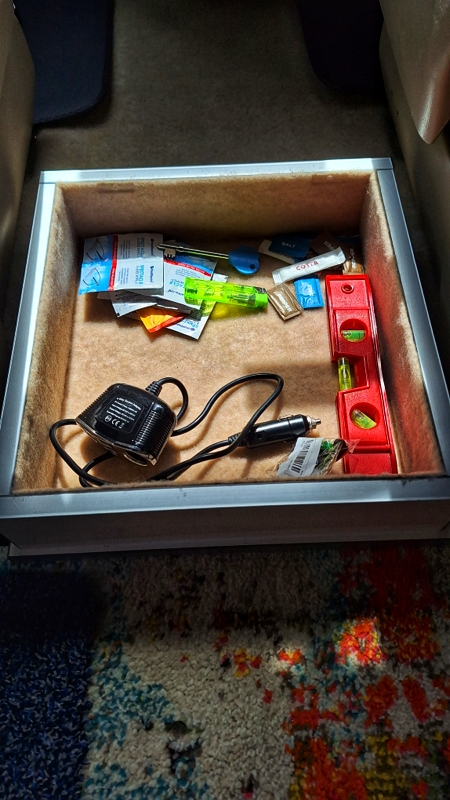
The small ‘centre console’ (not really: it’s just a low box installed between the seats that can be easily stepped over, rather than the OEM tall one) had nothing lining it so was noisy and rattly. This, I covered internally with stretch carpet, which is so much better.
‘Console’ (it also has a lift-off lid btw)
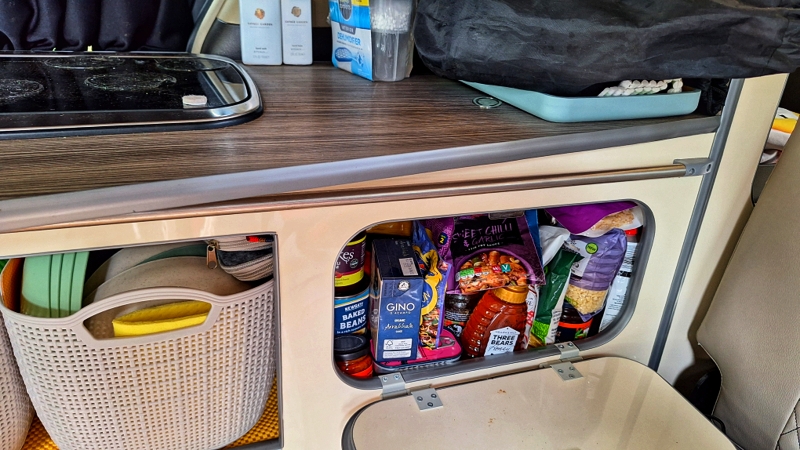
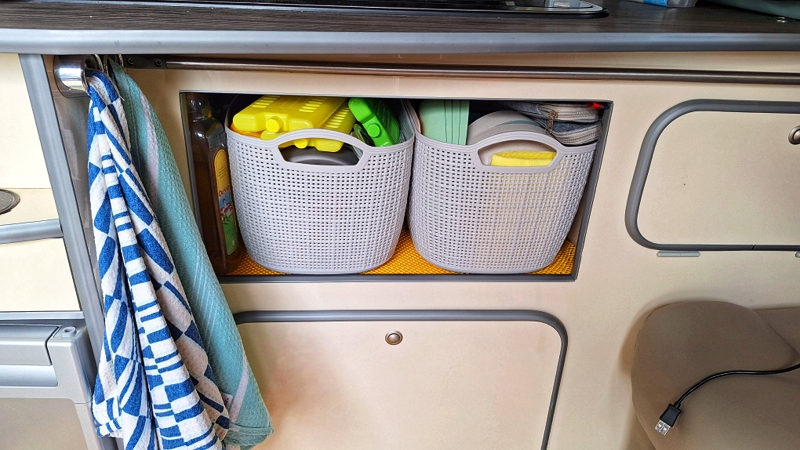
I also made a new shelf for the cupboard where the Sargent electrical supply unit had sat, and this has increased storage quite a bit. And while doing that I lowered the shelf in the adjacent open cupboard slightly, providing a small lip at the front so baskets can be used in there without sliding out every time we take a right-hand turn!
Where there once was a power supply unit, there are now more beans, honey, packs of pasta, etc…
…and baskets on a slightly lowered shelf
On the lighting and power sockets front, I’d already put in a twin mains socket with a couple of built-in USB outlets, and also added a couple of twin USB outlets to be accessible from each side of the bed.
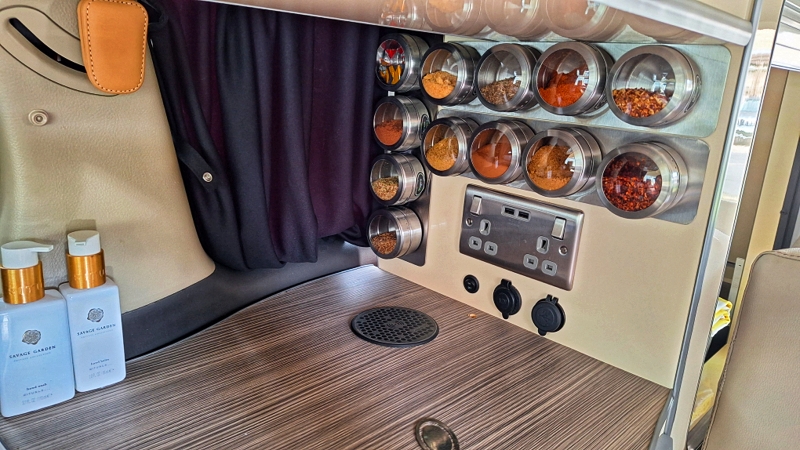
Sockets: 230v, 12v and 5v (and spice racks; lower one hiding the hole where the original Sargent control panel lived)
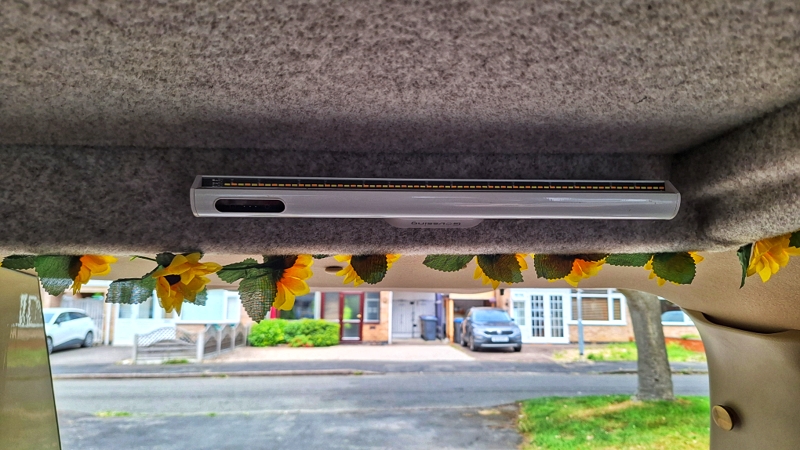
Lighting was also improved with a dimmable/rechargeable/removeable lamp in the rear of the pop-top’s aperture.
QD rechargeable lamp unit
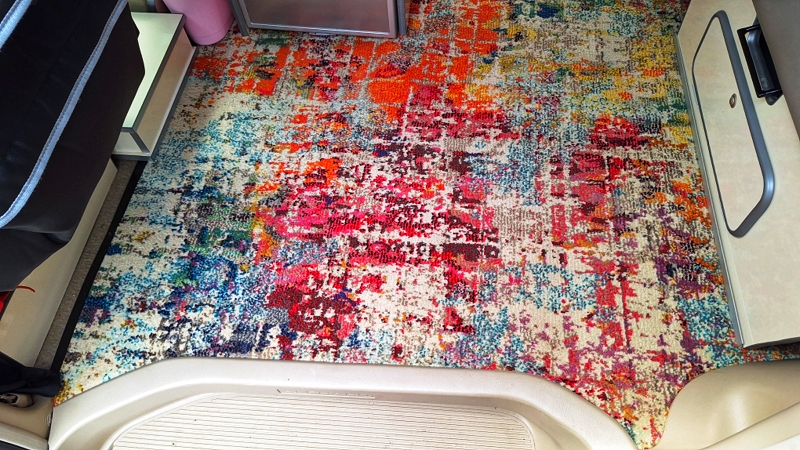
We decided that the flooring also needed a bit of an upgrade, so M deftly installed a fully fitted carpet which was fashioned from our old now-unused hearth rug – and rather good it looks too, I think.
New(ish) carpet
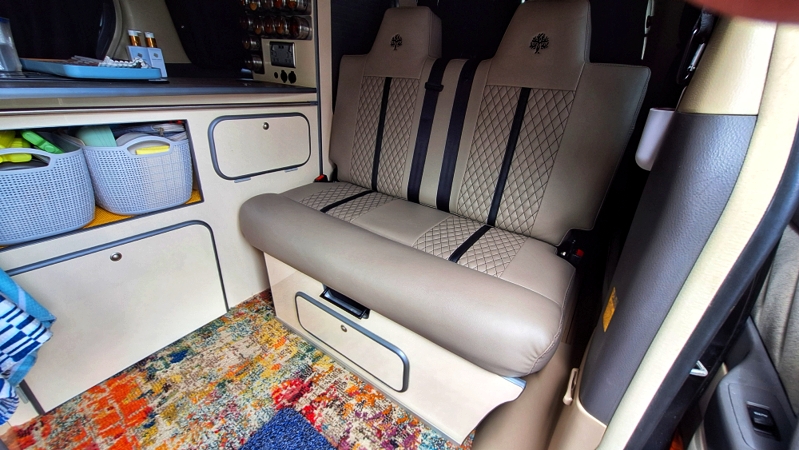
At the same time I modified the rock and roll bed’s front mounting position, bringing it a few inches forward which gave the seat back rather more recline angle, making it a lot more comfortable than the original bolt-upright position.
Rear seat base now sits about four inches forward of stock position for slightly improved lounging comfort
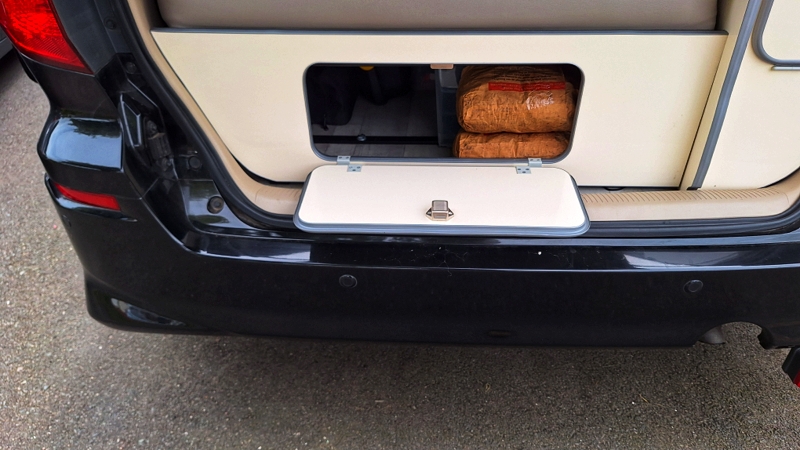
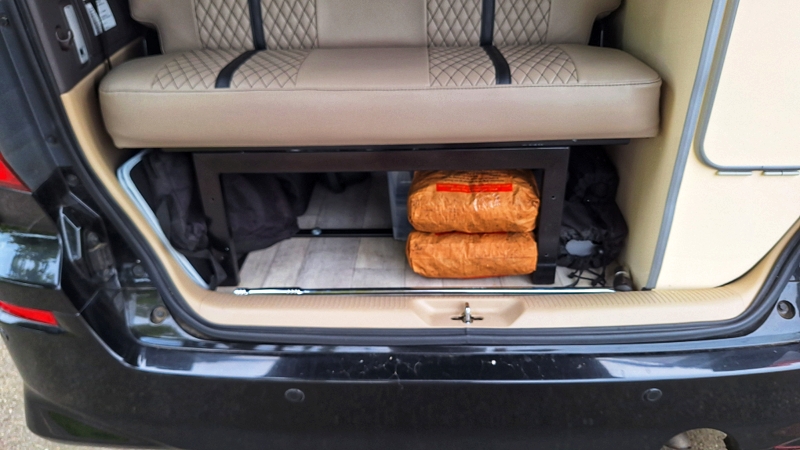
Back on the storage front, two subtle mods also help. Firstly, I simply removed the board (with its small hinged door) from the rear of the bed frame, thus giving much better access to all the space beneath the bed/rear seat. It was hopeless before. Now it’s much easier to cram in lots of kit. An easy but so-beneficial mod.
Before…
…and after
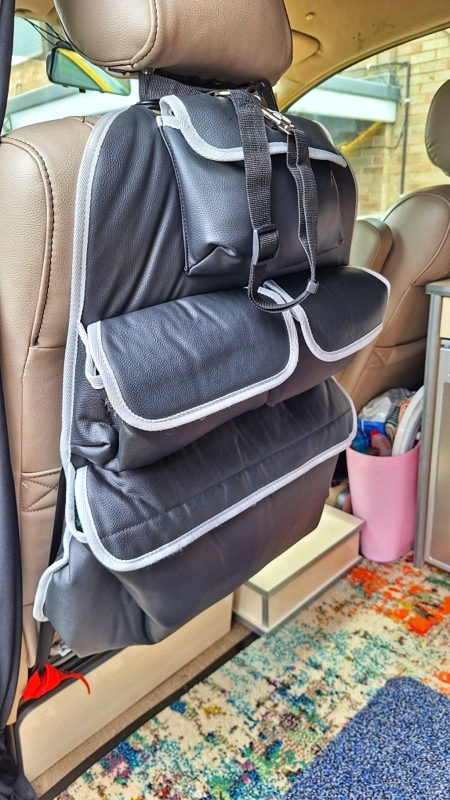
M also bought an Olpro storage bag which hangs from the back of the front passenger seat. This has multiple pockets for storing dog poo bags, treats, etc. etc.. It wasn’t easy to secure the bottom of it, and I’m not entirely happy with the way I’ve done it, so will revisit at some point.
Poo (bag) space
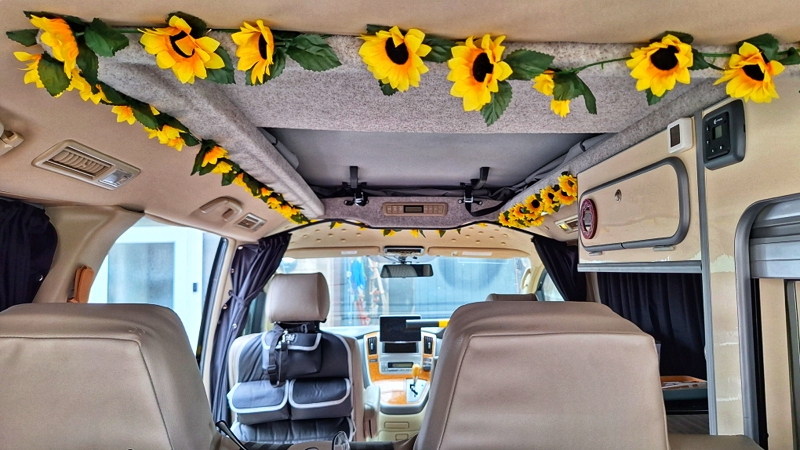
And finally, M brightened up the interior somewhat by adding strings of yellow flowers (fake, obvs) around the pop-top aperture. Very pretty!
Just like a florist’s shop. (Or maybe not)
I’m sure there are other small changes that I’ve forgotten about – oh, yes, rubber mats in the front footwells replacing the hideous ones that came with it – but that will do for now…
*I guess I could call myself Admin now really as M does virtually all the driving, but not having a name that is a reshuffle of the constituent letters of Admin, I won’t).
And it’s probably a bit thirstier (but cheaper overall).
By the way, this is a new series of blogs, rather than being an add-on to the previous series which is still available here. Blog 7.1 gives a little more insight too.
Those that followed our previous ZigZag Wanderer blog will know it was mostly about our travels in Western Europe in our 2022 6.7m Weinsberg Caracompact motorhome. However, if you’d been following closely you would have noticed that we had a few. erm. issues; namely eyes, something, something, something. I won’t go into it all here.
Anyroadup, the Weinsberg went (yes, we lost some money and a lot of development time if you class all the upgrades as that), and we bought a teeny tiny Toyota to replace it.
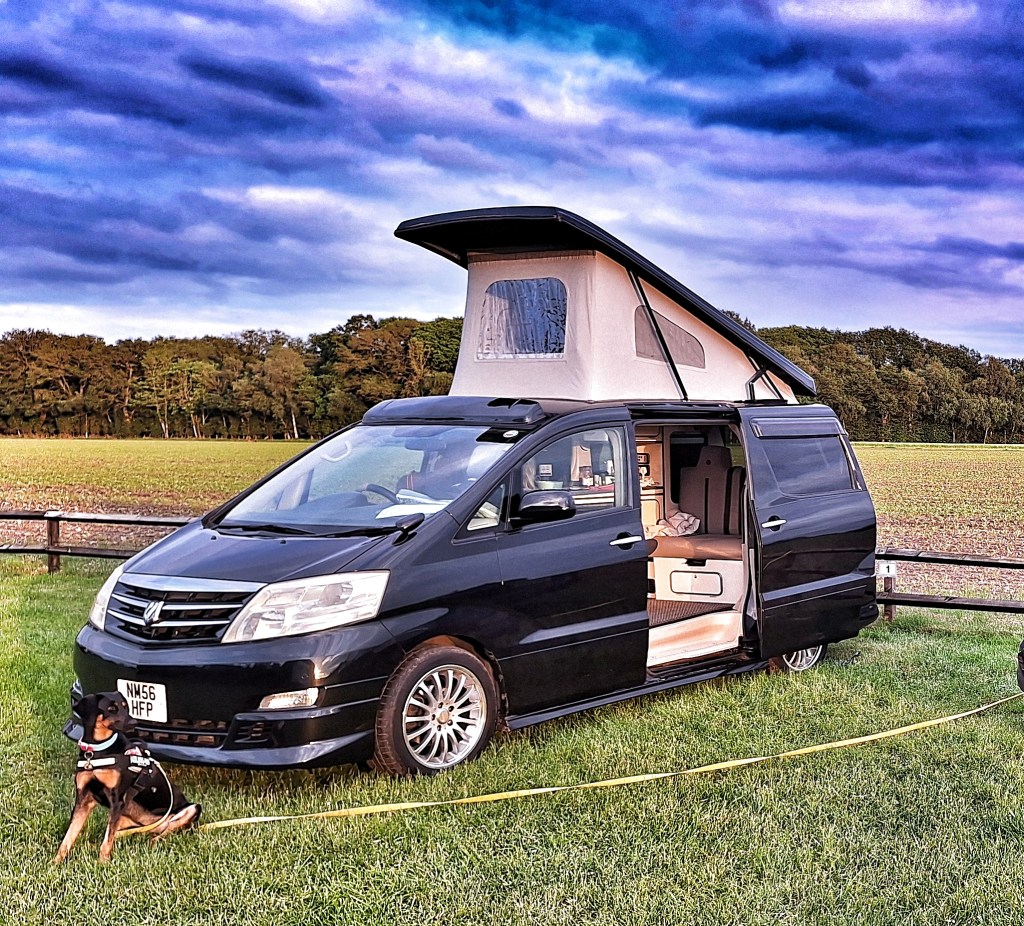
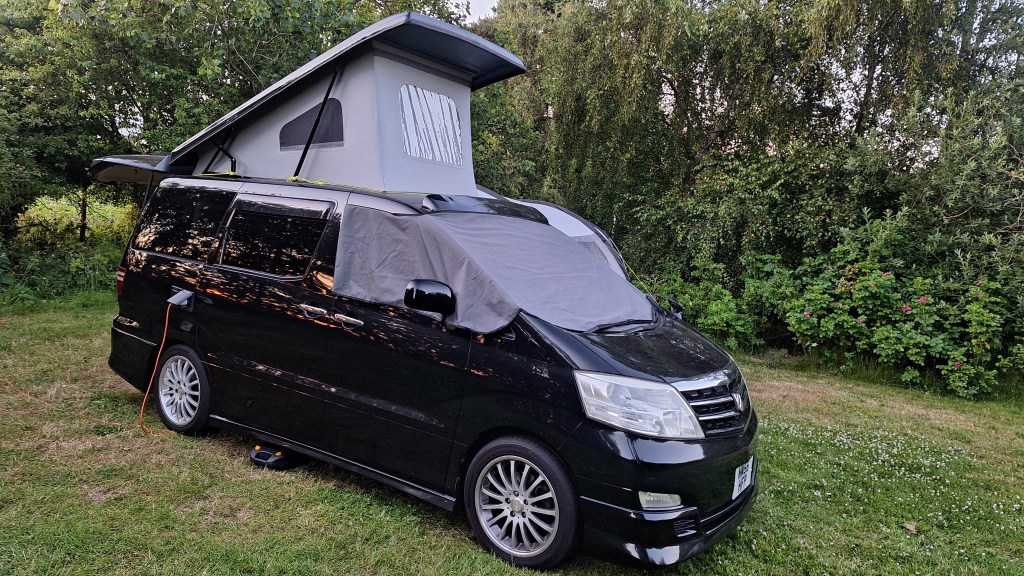
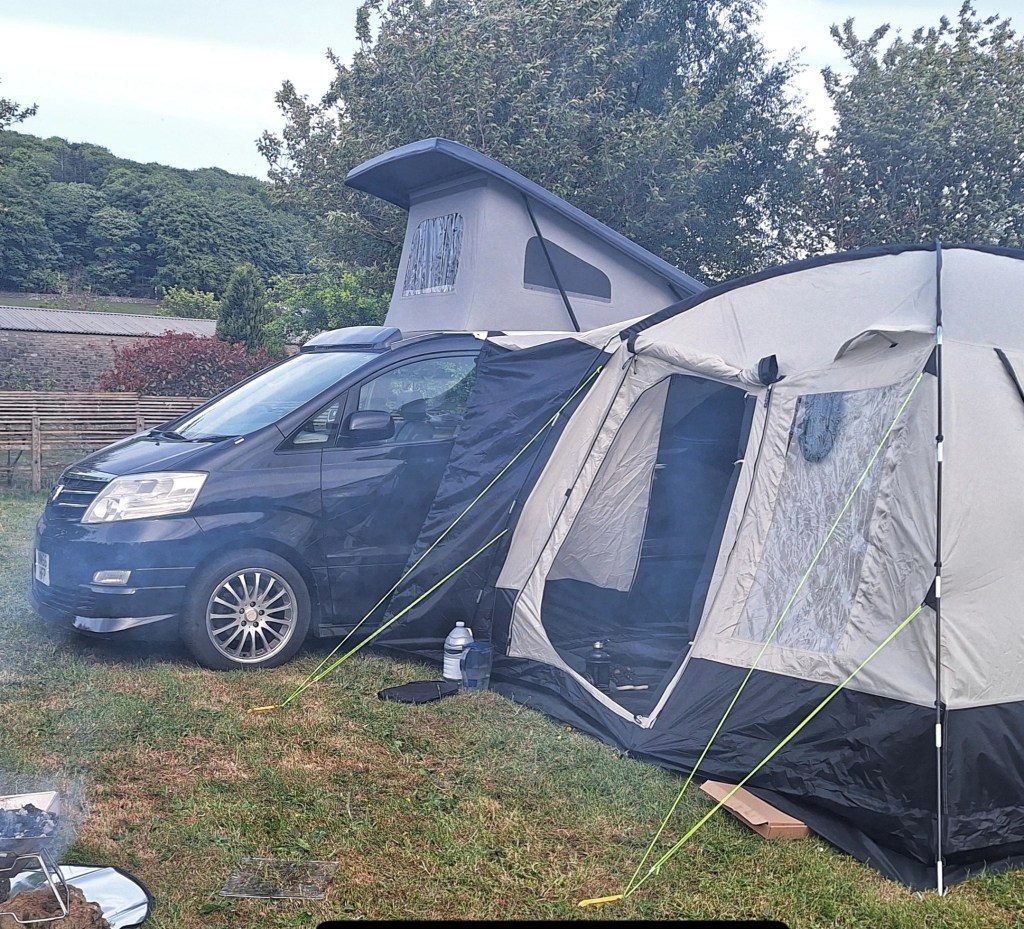
No, it’s not the normal Proace van (which is basically Stellantis anyway) or whatever, but a Japanese Domestic Market (JDM) Alphard that’sbeen around in Japan since about 2002.
On Guard, Lacy
As you might be able to ascertain, it’s a ‘People-carrier’ or MPV type of thing, which comes with, I think, seven or eight seats depending on spec level. This one is pretty old though, and I have no idea of its provenance in that respect. I suppose I could find out, but I can’t be bothered. What I do know is that, being a 2006 model, its designation is AH10. Later designs were called AH20 and AH30, with the latter I believe still being available in a few far eastern markets. They were never built in a LHD version anyway, so the markets for it are definitely limited (Japan, Australia, NZ etc) but are of course eminently suitable for UK roads. They have their foibles of course, in our case the vehicle came with an automatic toll reader and a radio that operates on different wavelengths to ours. Neither of these are particular issues though, just a redundant aerial in the windshield in the first case, and I’ve replaced the radio with an Alpine unit. (To be strictly accurate, the first UK owner had already replaced it with a fairly basic Kenwood unit, but I wanted a bit more functionality, DAB and so on).
There are quite a few over here, it seems, though, and we’ve seen a few, in Cornwall and in Lincolnshire, as well as locally. All are private imports, with some being kept in their ‘MPV’ many-seated spec as family cars (ideal, too), while many, like ours, have been converted to various styles of campervan. Ours is a traditional side kitchen and ‘rock and roll’ bed type like so many VW Transporters, while quite a few are rear kitchen variants. You pays your money, etc. The original import and conversion was done by All Seasons up in County Durham (or maybe Newcastle – I can never work it out for some reason. All I know is that when I called them with a query during our early days of ownership they were less than helpful. Fortunately we have New Acre just down the road near Alcester, and they have a fabulous reputation in this field. We’ll certainly use them if it becomes necessary).
Bailiff’s Cottage, Suffolk, June 2024
Speaking of which, the Alphard, like most Toyotas – and we speak from the experience of having owned a few – has a very good reputation for reliability. If it didn’t, we’d’ve shied away given the fact that Toyota doesn’t specifically support the model in the UK for obvious reasons. Having said that, though, although we haven’t had to prove it ourselves as yet, many owners report that some dealers will often go out of their way to source parts. There are many Facebook Alphard groups too, and a web forum, along with a couple or three You Tubers who are good sources of information. Service kits are easily available on Ebay etc, and of course any decent local garage (in our case the wonderful Tollgate Garage here in ‘incleh) will service and MOT them. Fortunately, too, many parts are interchangeable with other Toyota models such as Camry and RAV4, and the engines (2.4 litre 160bhp four-cylinder chain-driven camshaft petrol in our case) are mostly bulletproof, to use an oft-misused phrase.
Peak Forest (with barbecue smoke), May 2025
Which brings us onto running costs, and that ‘Thirstier‘ part of the title. It’s not that bad, in truth. In fully-laden camping trim, and given that the torque converter transmission is only a four-speed, it returns around 25mpg, which is admittedly no better than our previous much larger and heavier (and diesel) moho. However, petrol’s that bit cheaper, and for the comfort and quietness of the ride, we’ll take that. The days of a commercial van-based coachbuilt crashing over every slight dent in the road, while having to row the gearshift up even the slightest incline, are well behind us.
That’s not to say we don’t miss some aspects of the Caracompact. Oh, those lovely beds… And of course all the electrical mods like the 400w solar, 230ah lithium battery, 50 amp charger etc. No, it was a good van, but we had to trade all that due to a couple of health issues (one each) and we’ll happily live with the compromises if it allows us to resume ZigZag Wandering.
One aspect that is absolutely, definitely not a compromise, is the parkability. What I mean by that is the fact that, being a hair under five metres long, and a couple of thumbnails under two metres high, we can squeeze under virtually any height barrier, and into any car park space. Which is bliss when you look at the corresponding dimensions of the Weinsberg (6.7m and approaching 3m high). Oh the times we were turned back due to our van’s size.
Win win there, then.
So, that’s just an introduction to our new (to us) campervan. Shortly, I’ll do an update on the few mods that have already been completed – and one or two more I’d like to do, and then one on the trips we’ve undertaken thus far (and reveal where and when our next major(ish) tour commences.







 ZigZag Wanderer