23rd February 2026
Well, we took the plunge, and bought another van.
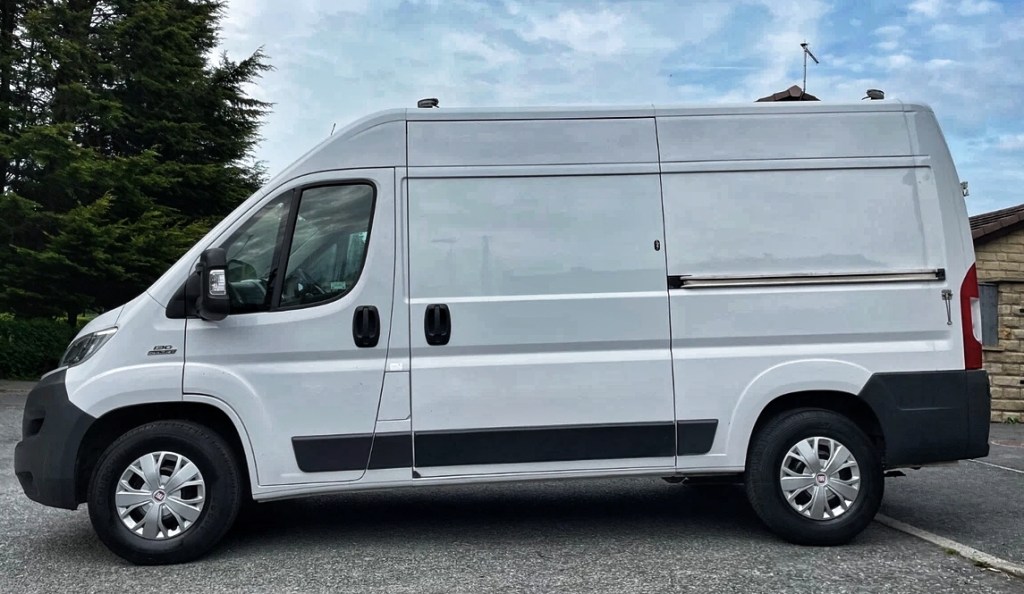
As I said in Blog 8.14 the Alphard was as tight for space as we feared, particularly during a long-term trip in iffy weather, so we started looking for either a part-converted panel van, or a bare, unconverted one.
A couple of weeks ago, I thought we might have cracked it when I spotted a (converted, but needing plenty more work to suit our needs) Citroen Relay. It looked an ideal base as it already had a big (628ah) battery and lots of solar (600w) on the roof. There were drawbacks, but overall it seemed a good start, so I tried to arrange a viewing, letting the owner know that the cash was waiting, and that I was prepared to pay the asking price should it prove to measure up to the description.
Well, I tried, but then the owner just clammed up. Completely. I can only assume they had another offer. That’s fine in itself, but it’s just rather rude and cowardly to just refuse to respond to messages.
Still, they say things happen for a reason…
We kept searching on ebay, Quirky, Gumtree, etc. and eventually I spotted something that seemed like it might make a basis for a decent camper build: an ex-BT Ducato L2H2. It’s a little older than the other one (same basic platform though) with a slightly smaller engine, but one that doesn’t rely on AdBlue for its Euro6 compliance – which, to me, knowing all about the downsides of AdBlue, is a bonus. Another bonus is that the engine is the Fiat/Iveco one that has such a good reputation. The later replacement 2.2L Peugeot/Ford one does not.
It also feels quite perky on the road compared to our old, more powerful 2.2L motorhome, but that’s down to the fact that it’s currently empty… A good reason to keep the conversion as lightweight as possible, then.
It also has a solid history, had the cambelt and water pump changed last year, and has a 12 month MOT with no advisories.
OK, it’s the basic model, shorn of a few luxuries, but in its favour it has a single passenger seat, unlike the Citroen, which had the far more common twin-seat passenger set-up. This is something I was going to have to budget for to change, as we want a single swivel seat only. And single seats ain’t cheap to buy (you’re talking several hundreds of pounds). All right, I’ll still have to buy a swivel sub-base for it, but that’s way cheaper than having to buy the whole kit and caboodle.
Elsewhere in the cabin area, it’s immaculately clean: no evidence of muddy boot wear, or ciggy stink, no discernable wear on steering wheel or armrests, and frankly, the seats don’t look like they’ve ever been sat in! So there’s not much to do in that area.
It came with security hook locks to the load area doors, but none on the cab. However, I quickly resolved that shortcoming, calling on Edlock to come out and install them. A very good, fast, service from them (again), and I’d thoroughly recommend them.
I will need to remove and dispose of the cab bulkhead, which is fairly straightforward – they just bolt in. The cab roof will have to be sound-deadened and insulated, but that’s about it I think.
In the habitation area, things will be kept quite simple. Base kitchen units will have three or preferably four drawers and a couple of cupboards, and the worktop will carry a top-mounted sink and separate tap which will be fed from a submersible pump in a receptacle stored in the cupboard below. There will also be a grey water receptacle beside that. These don’t need to be particularly large as we learned from the Alphard that we could get away with carrying very little water, just picking up drinking water when needed. We’ll have a fairly large ‘garage’, too, in which we can store extra drinking water if we should need to.
As supplied, the van came with the very desirable, and expensive, Eberspacher diesel night heater and a 1.5kw 12v-230v inverter. The former will probably be discarded in favour of a new Autoterm installation, relocating under the driver’s seat, while the inverter will also come out, to be sold, and replaced with at least a 2kw one, but possibly a 3kw one. There’s also a 95Ah AGM leisure battery, a split charger, and a fuse box, all of which have now been removed. Unfortunately, there is also lots of associated wiring for all this gubbins, all very professionally installed and conduited, and a lot of it seemingly integrated with the original Fiat wiring and conduits, so I’m rather hesitant to start chopping too much out so it will probably remain, encased in the hab area insulation.
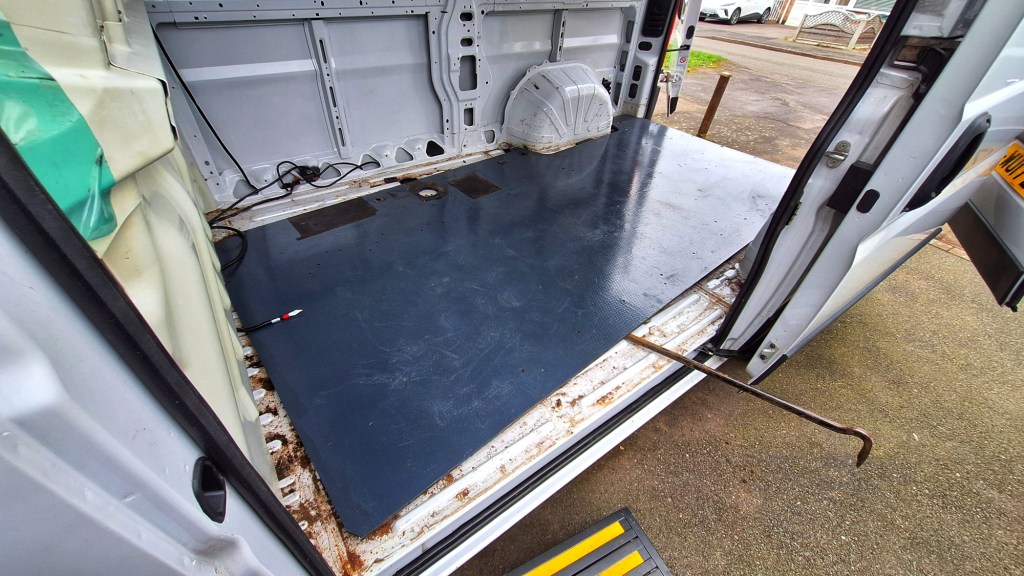
Floor coming out. Not easy, screwed down, and very heavy. That’s not rust btw – just dust and muck. The black patches are witnesses to the battery, night heater, and fusebox.
However, aside from all that, the first thing internally was to lift the floor plywood so as to reveal the steel so that this can be thoroughly prepped ready for sound-deadening, insulating and the new floor, rear wheel boxes, and the floor covering; probably just heavy-duty vinyl with rug(s) over. At the same time, the bulkhead came out. A simple job, as it’s just secured with a few M6 bolts.
The floor of the van proved to be totally sound. The only hint of rust was a little bit of surface corrosion by the rear doors (they all do that, apparently) which was very easily dealt with. After very lightly Scotching the whole floor, and vacuuming it out, I applied a couple of coats of red oxide to any scratched areas and over all seams and screw perforations. The underside will also be treated before being Lanoguarded (as usual!).
Next steps: Acquire sound-deadening and insulating materials, lots of ply, windows, and roof fan.
More soon.
 ZigZag Wanderer
Leave a comment