Blog 8.1 – Smaller. Quicker. Quieter. Thirstier
It’s certainly smaller and quicker.
it’s definitely quieter.
And it’s probably a bit thirstier (but cheaper overall).
By the way, this is a new series of blogs, rather than being an add-on to the previous series which is still available here. Blog 7.1 gives a little more insight too.
Those that followed our previous ZigZag Wanderer blog will know it was mostly about our travels in Western Europe in our 2022 6.7m Weinsberg Caracompact motorhome. However, if you’d been following closely you would have noticed that we had a few. erm. issues; namely eyes, something, something, something. I won’t go into it all here.
Anyroadup, the Weinsberg went (yes, we lost some money and a lot of development time if you class all the upgrades as that), and we bought a teeny tiny Toyota to replace it.
No, it’s not the normal Proace van (which is basically Stellantis anyway) or whatever, but a Japanese Domestic Market (JDM) Alphard that’sbeen around in Japan since about 2002.
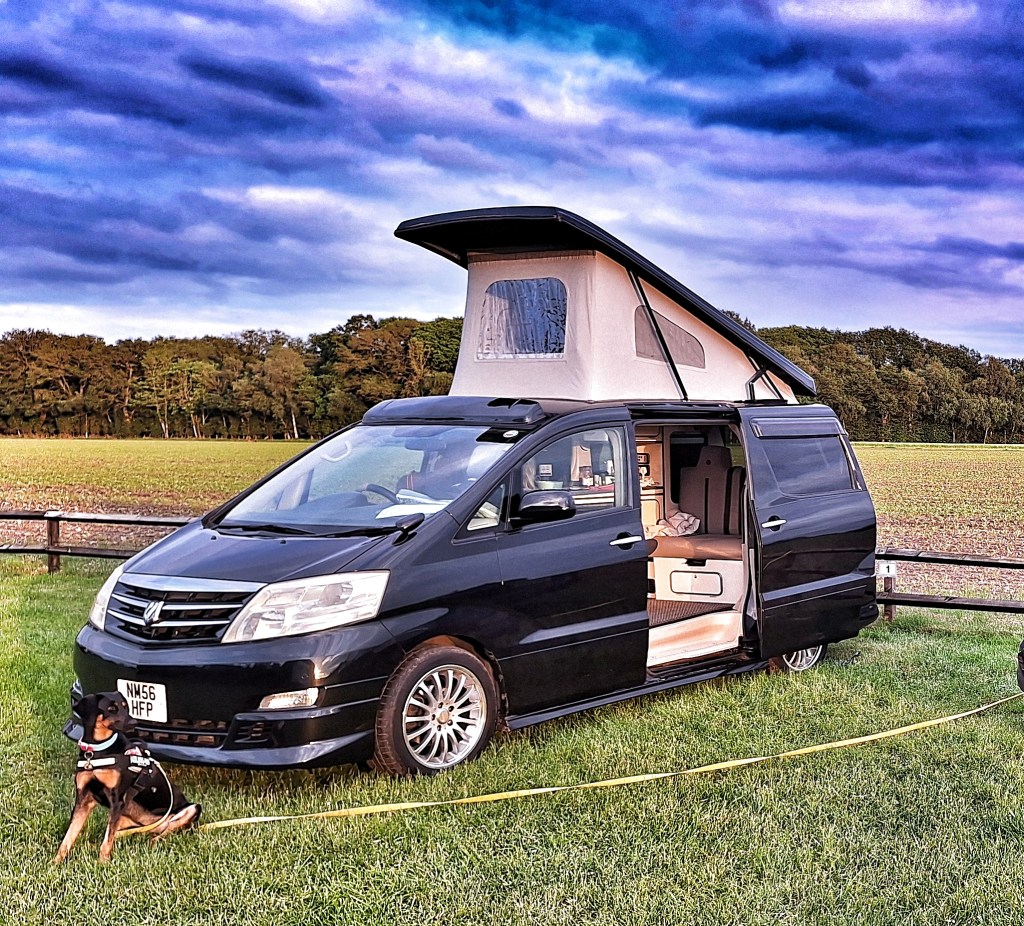
On Guard, Lacy
As you might be able to ascertain, it’s a ‘People-carrier’ or MPV type of thing, which comes with, I think, seven or eight seats depending on spec level. This one is pretty old though, and I have no idea of its provenance in that respect. I suppose I could find out, but I can’t be bothered. What I do know is that, being a 2006 model, its designation is AH10. Later designs were called AH20 and AH30, with the latter I believe still being available in a few far eastern markets. They were never built in a LHD version anyway, so the markets for it are definitely limited (Japan, Australia, NZ etc) but are of course eminently suitable for UK roads. They have their foibles of course, in our case the vehicle came with an automatic toll reader and a radio that operates on different wavelengths to ours. Neither of these are particular issues though, just a redundant aerial in the windshield in the first case, and I’ve replaced the radio with an Alpine unit. (To be strictly accurate, the first UK owner had already replaced it with a fairly basic Kenwood unit, but I wanted a bit more functionality, DAB and so on).
There are quite a few over here, it seems, though, and we’ve seen a few, in Cornwall and in Lincolnshire, as well as locally. All are private imports, with some being kept in their ‘MPV’ many-seated spec as family cars (ideal, too), while many, like ours, have been converted to various styles of campervan. Ours is a traditional side kitchen and ‘rock and roll’ bed type like so many VW Transporters, while quite a few are rear kitchen variants. You pays your money, etc. The original import and conversion was done by All Seasons up in County Durham (or maybe Newcastle – I can never work it out for some reason. All I know is that when I called them with a query during our early days of ownership they were less than helpful. Fortunately we have New Acre just down the road near Alcester, and they have a fabulous reputation in this field. We’ll certainly use them if it becomes necessary).
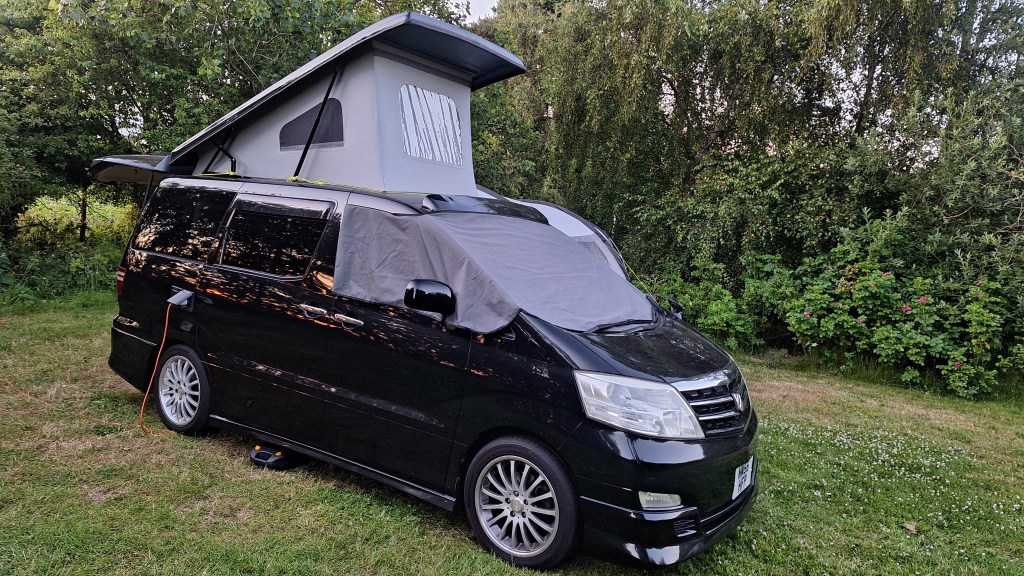
Bailiff’s Cottage, Suffolk, June 2024
Speaking of which, the Alphard, like most Toyotas – and we speak from the experience of having owned a few – has a very good reputation for reliability. If it didn’t, we’d’ve shied away given the fact that Toyota doesn’t specifically support the model in the UK for obvious reasons. Having said that, though, although we haven’t had to prove it ourselves as yet, many owners report that some dealers will often go out of their way to source parts. There are many Facebook Alphard groups too, and a web forum, along with a couple or three You Tubers who are good sources of information. Service kits are easily available on Ebay etc, and of course any decent local garage (in our case the wonderful Tollgate Garage here in ‘incleh) will service and MOT them. Fortunately, too, many parts are interchangeable with other Toyota models such as Camry and RAV4, and the engines (2.4 litre 160bhp four-cylinder chain-driven camshaft petrol in our case) are mostly bulletproof, to use an oft-misused phrase.
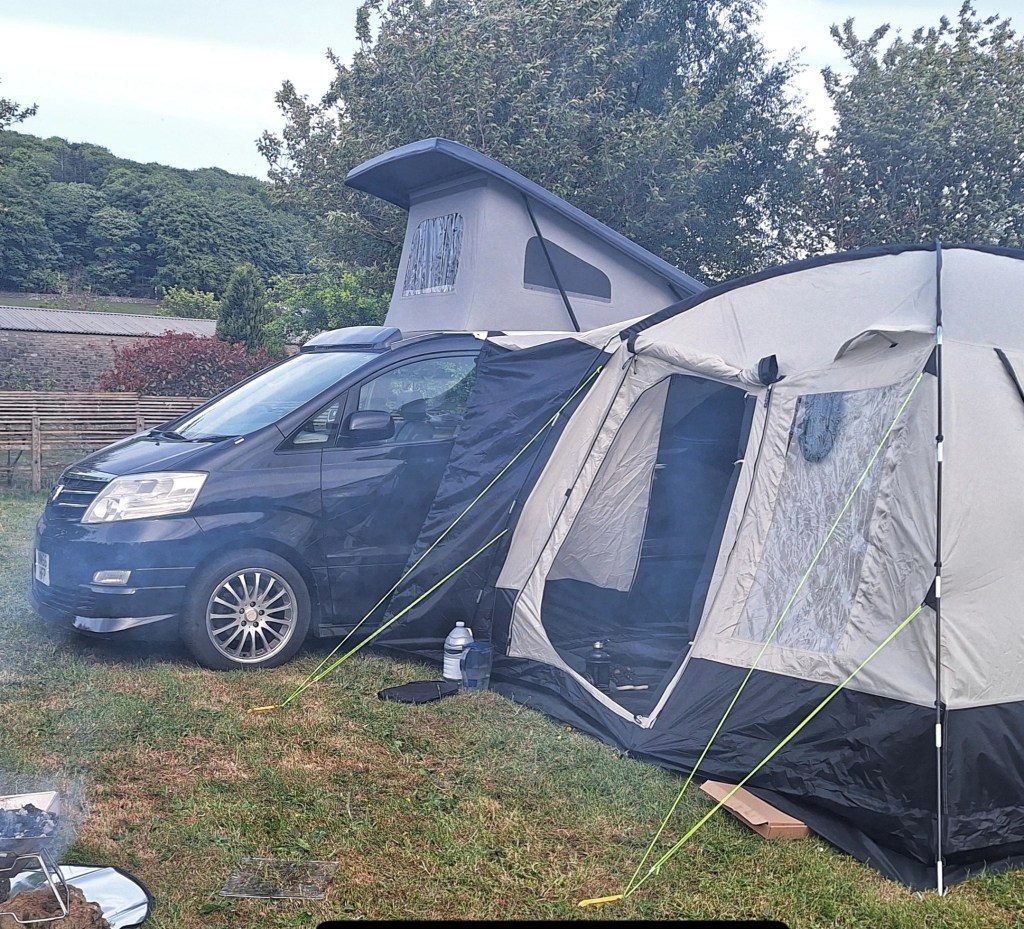
Peak Forest (with barbecue smoke), May 2025
Which brings us onto running costs, and that ‘Thirstier‘ part of the title. It’s not that bad, in truth. In fully-laden camping trim, and given that the torque converter transmission is only a four-speed, it returns around 25mpg, which is admittedly no better than our previous much larger and heavier (and diesel) moho. However, petrol’s that bit cheaper, and for the comfort and quietness of the ride, we’ll take that. The days of a commercial van-based coachbuilt crashing over every slight dent in the road, while having to row the gearshift up even the slightest incline, are well behind us.
That’s not to say we don’t miss some aspects of the Caracompact. Oh, those lovely beds… And of course all the electrical mods like the 400w solar, 230ah lithium battery, 50 amp charger etc. No, it was a good van, but we had to trade all that due to a couple of health issues (one each) and we’ll happily live with the compromises if it allows us to resume ZigZag Wandering.
One aspect that is absolutely, definitely not a compromise, is the parkability. What I mean by that is the fact that, being a hair under five metres long, and a couple of thumbnails under two metres high, we can squeeze under virtually any height barrier, and into any car park space. Which is bliss when you look at the corresponding dimensions of the Weinsberg (6.7m and approaching 3m high). Oh the times we were turned back due to our van’s size.
Win win there, then.
So, that’s just an introduction to our new (to us) campervan. Shortly, I’ll do an update on the few mods that have already been completed – and one or two more I’d like to do, and then one on the trips we’ve undertaken thus far (and reveal where and when our next major(ish) tour commences.
See you then.
 ZigZag Wanderer
Leave a comment